

The Haushalter Farm:
A Memoir by Mack Robinson
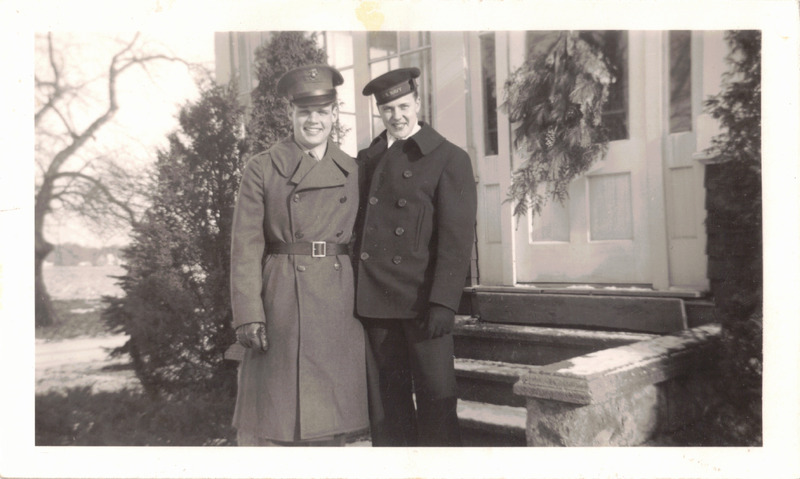
As Spring approached in 1941, two exciting opportunities developed for me. First, I was invited to spend a month, or more, in Arizona during the next summer with a group of Mormon cowboy Boy Scouts, and my old Camp TIWAYEE councilor of 1936, Harold Kassel. It would cost me about $150. I had saved a little money, but needed more.
Then, second, Carl Haushalter's Dad asked me if I'd like to work on their farm that spring on my free days. The pay was 45 cents an hour for a nine hour day. That came to $4.05 a day. I jumped at it.
I worked Saturdays and Sundays as soon as spring planting season started. I'd take a brown bag lunch and hop on my bike and ride across Hamburg, over the bridge across 18 Mile Creek at the Water Valley Hill. The Haushalter truck farm was on the left-hand side of the road, just across the creek. I'd help Carl clean out the manure from the barn where they kept a couple of horses and a cow. I helped water the new young vegetable plants sprouting in seed beds in the greenhouse.
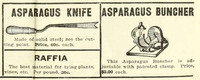
One of my earliest jobs was cutting asparagus. I was given a stick with a V-shaped, sharpened weed cutter on the end, and a basket. I had to cut the asparagus shoots below the soil surface an inch or so when the shoots were long enough to be of marketable size. There were several acres of these perennial plants to be "screened" early each morning. I brought the filled baskets to a small barn where Mrs. Haushalter would bundle them and trim the stems, wrap them and pack them in boxes for market.
Next, I'd weed the carrots and beets with a hoe. Rows and rows of them. As the sun became hot someone would come out with a water jug now and again for a cool drink of water. Meanwhile, Carl and his Dad and a Scandanavian hired man were plowing, spreading manure and 5-10-5 fertilizer, and harrowing the main fields in preparation for planting. When they were ready, acres of tomatoes, pepper, watermelon, cantalope, cabbage, cauliflower and rutabaga were planted.
The Haushalters had a horse-drawn planter. It had a tank for water and a platform which could hold a man and a tray or two of seed plants from the greenhouse. As the planter was pulled along the row, a small plow would open a furrow a few inches deep in the rich, loamy soil, and a small stream of water would trickle into it. The person planting would drop the small plants in at a proper distance apart, and the furrow was covered over again. It was slow, tedious work. As the trays of new plants were put in the soil new trays would be brought out on the farm wagon. A few days after the planting had been done we would go over the fields and fill in plants where there were gaps, or where the original plants had died, until all the acreage was fully planted.
The next chore was putting in the sprinkler system. The long metal pipes with holes in them were taken out of storage. They were pieced together and put up on cement blocks. When the system was completed, it was attached to a pump which drew water from 18 Mile Creek and sprayed it over the fields. Every few days we would have to move the pipes from one field to another.
As I gained knowledge and skill I was allowed to help more and more. It was hard, back-breaking work. In fact, it was the hardest labor I ever had to do. It wasn't so bad when I only worked Saturdays and Sundays, but after school was out the middle of June I worked for several weeks full time, six days a week. I made up my mind I didn't want to be a truck farmer, and I understood completely Carl's desire to get off the farm.
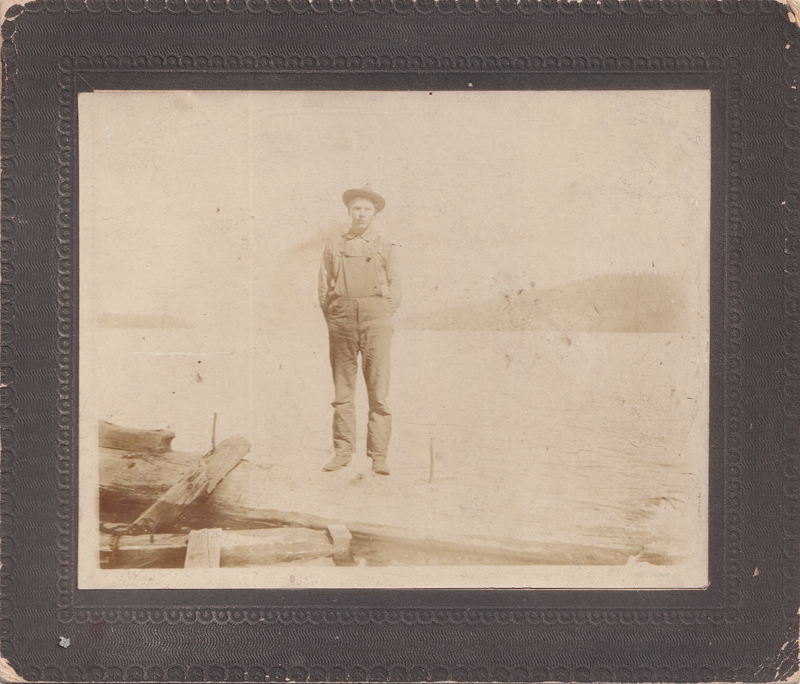
I discovered that Carl's Dad hadn't really wanted to be a farmer either. The farm had been his father's farm. He had grown up on it. But he left home as a teenager and went West to Idaho and became interested in lumbering. Idaho's forests were just being opened up in the early 1900's. One day Mr. Haushalter received word that his father [was struggling with mounting debt],[1] and he was needed at
home to [take over the farm].[2] He returned to Hamburg reluctantly, and was "stuck" on it ever since. In his yard alongside of the house were three large Douglas Fir trees. They were grown from seedlings Mr. Haushalter had brought back with him from Idaho.
As the vegetables began to develop and fill out, we were involved in weeding them. Also, I remember well tying "culli.” I would be given a thick hank of strands of binder twine about a yard long, which I looped over my trousers’ belt. I would start down a row of rapidly-growing cauliflower plants. At each plant I'd reach under the outside leaves and wrap them around the head, and tie the leaves over the head so as to cover it and allow the head to bleach out as it grew. Later, when the heads were fully developed, we'd cut them off at the ground and fill a wagon with them. They were then taken to a barn where Mrs. Haushalter, or Carl, or his Dad would slice off the outer leaves exposing the head and trim the side leaves, and wrap and pack them into crates for market.
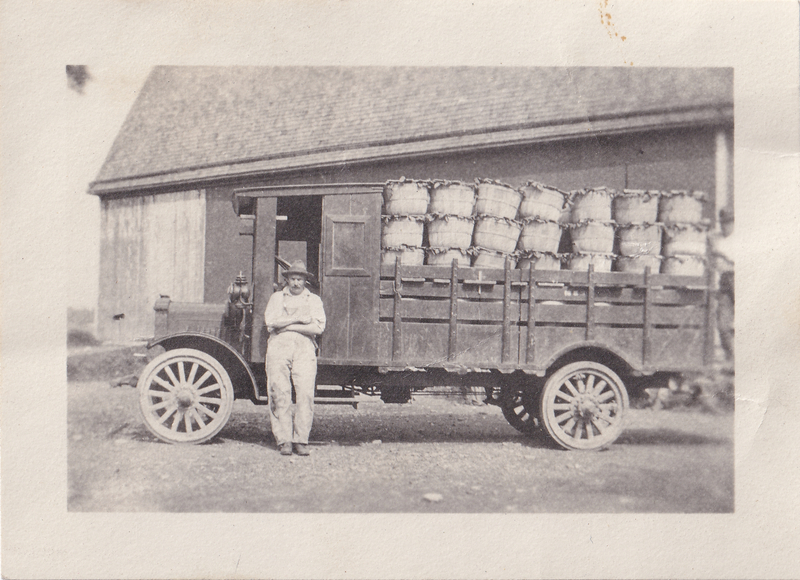
On the day before market days, all the produce was packed into the Haushalters' truck before dark. At about 3 a.m., Carl and his Dad would be up and headed for market in Buffalo. Their produce was all sold before noon, and they would be back home, ready to spend the afternoon in the fields.
When the sweet bell peppers were ripe, we would pick them in the fields in bushel baskets and bring them to the barn. There, Mrs. Haushalter and sometimes her elderly [father-in-law],[3] who lived across the road, would sit with soft cotton rags and clean the dirt off them, separate the red from the green peppers, and repack them for market.
When the tomatoes were ripe, everyone had to work very rapidly to get them out of the fields and to market before they spoiled. It meant going over the fields day after day to pick the ripe fruit. I remember I picked 85 bushels of tomatoes one day.
When the cabbage was ripe, I remember Carl's Dad didn't have a market for all he had raised, and they were beginning to get beyond their prime. Then, one day he said a semi-trailer would be in to take all we could give them. We worked feverishly cutting wagon load after wagon load until well after dark. We loaded the semi-trailer to the top. I always wondered how much of the cabbage was fit for human consumption by the time it got where it was going. But Carl's Dad was saved from a considerable loss.
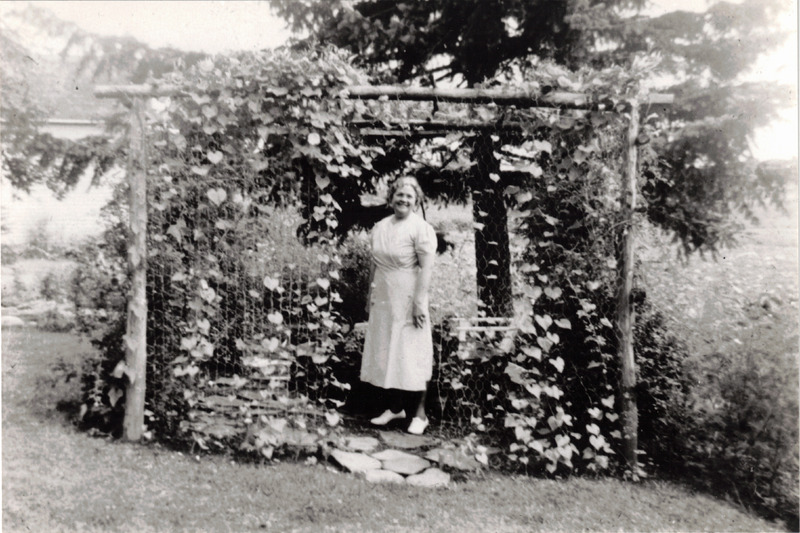
I remember during our lunch breaks I'd sit in the shade of the Haushalter grape arbor. They had a large family garden where Mrs. Haushalter [raised flowers - June],[3] and there were several rows of Concord grapes in that area. The Lake Erie shoreline from Buffalo to Fredonia, N.Y. and on into Pennsylvania and Ohio is a prime area for growing grapes. When the Haushalters' grapes were ripe, we were permitted to have a bunch now and then at lunchtime. They were delicious.
The hired man who worked with us was one of a dying breed. He was a rather good-looking, raw-boned Scandanavian fellow, who drifted around the country picking up work where he could. He was quiet, but friendly. He chewed Copenhagen snuff. His principal form of entertainment was to go to local barn dances on Saturday nights with a bottle, and look for an "available" farm girl. He told us his technique was very straightforward. He'd ask a girl he liked the looks of to dance. After a minute or two of small talk, he'd ask her if she liked to. lf she said, "No," or acted insulted, he would take her off the dance floor and say, "Goodbye". Then he'd try the same thing with another girl. He said he seldom failed to "make out" before the evening was over. He was very matter-of-fact about it. Carl and I, at age 17, were impressed, and a bit incredulous.
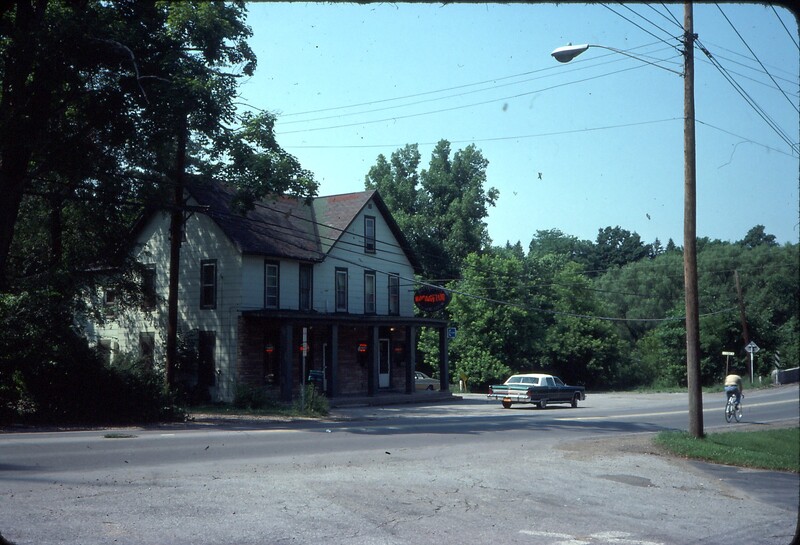
Sometimes, on Saturday night, after work was over, Carl and I, with permission, would go over to the small tavern which was just across the road from the Haushalter farm. [The Water Valley Inn - John.][4] On Saturday nights they often had fish fries of Lake Erie Whitefish. A plate of fried fish and chips was inexpensive, because it was used to attract people to the tavern. The owners knew Carl well, and would sell us paper plates filled with fish and French fried potatoes, which we would eat in the field along the highway.
Carl and I would also, on occasion, wander down to 18 Mile Creek after work and take a dip in one of the deeper pockets of water. Carl knew the swimming holes well. They weren't very large, but they were refreshing. With all that hard work in the open, I soon began to be in excellent […].[5]
Footnotes
- ^ Liz Casler Loomans: This is the understanding of the "why" behind Charles' return that I have from my father, aunt and grandmother (June Haushalter Casler). There is evidence in 1893 Buffalo area newspapers of foreclosure rulings against George H. Haushalter. It's unclear to me as yet whether whatever troubles existed in 1907 (the year Charles returned) were a continuation of those old problems or something new.
- ^ Existing bracketed insertion by unidentified transcriptionist—almost certainly June Haushalter Casler or Carl Haushalter.
- ^ June Haushalter Casler
- ^ John Casler, June Haushalter and Edwin Casler's son.
- ^ Unfortunately, the physical copy of Mack Robinson's account of his summer in the archive ends abruptly here. However, I (Liz Casler Loomans) am hopeful that I may find a complete copy elsewhere in the archive, or that one of the other living descendants of the Haushalters may have it.