

Asparagus à la Charles & Anna
In this recipe essay of rather an unusual sort, Carl Haushalter, son of Charles and Anna, walks his reader through what a typical day harvesting asparagus on the Haushalter farm was like.
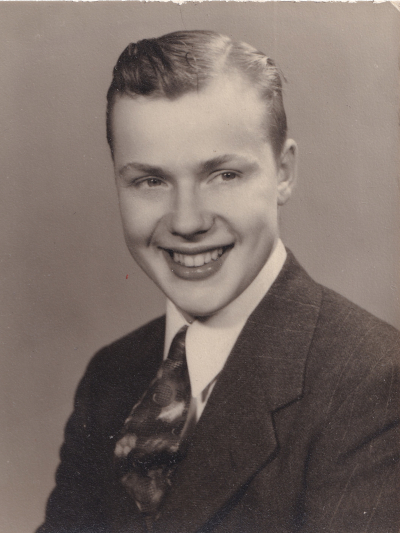
Associated Family Members:
Carl Haushalter, Anna Haushalter, Charles Haushalter
Asparagus à la Charles and Anna
Prep: Years
Cook: 7-10 mins
Serves: A family of 5 happily, or 6 if Grandpa joined us that evening
Ingredients
Bunches of thin, stringy stalks of asparagus.
Instructions
Have enough boiling water in a skillet to cover the selected quantity of asparagus stalks. Boil gently 7 to 10 minutes. Drain and plate, adding butter, salt and pepper to taste.
Step 1: Field Prep
Late May or early June, get up at sunrise, roll out Uncle George's homemade Asparagus cart with the dismantled buggy wheels, place two empty bushel baskets in the front rack of the cart and two more in each side rack. Pull the cart out from between the ice house and the end of the truck barn. Put water in the trough under the grindstone wheel. Get Carl or the hired man to turn the wheel crank while Charley personally sharpens a selection of V-tip Asparagus knives. (This re-sharpening will be repeated three or four times a day before every harvest run.)
Though he would later become one of the United States' leading experts on military applications of radar, space and aircraft engineering, as well as a valuable CIA Cold War asset, Carl spent the formative years of his life as every Haushalter did, helping out on the farm. The earliest of those years (Carl was born in 1925) were shadowed by The Great Depression.
For the first morning cut, proceed down the lane to the Asparagus field behind the chicken yard. Three hands [people] are preferred, one pushing the cart and straddling two rows and one on each side cutting two rows each. Bend over and cut each stalk 1–2 inches below the ground and place the harvested stalks carefully with the tips up into the basket. Meanwhile, the center hand alternately cuts and pushes the cart forward until reaching the end of the patch just over the rise and about eighty feet from the rim of the gully. Push and U-turn the cart to engage the next six rows and proceed back towards the chicken yard. (This second, return run will be on the other side of the row.) Once you are at the end of the rows, it is recommended that you slowly try to stand upright—just to make sure you can—before proceeding to the next row or to the barn.
If, at the end of any round trip, all baskets are pretty full, return to the barn. If less than half full, load the harvested stalks into three or less of the baskets to lighten the cart for the next round-trip. If reasonably late in the lunch period, you may return to the barn with less than full bushels.
As inspiration for tomorrow, on the last run of the day, take note that in the rows cut earlier this morning, the stalks are ready to be cut again.
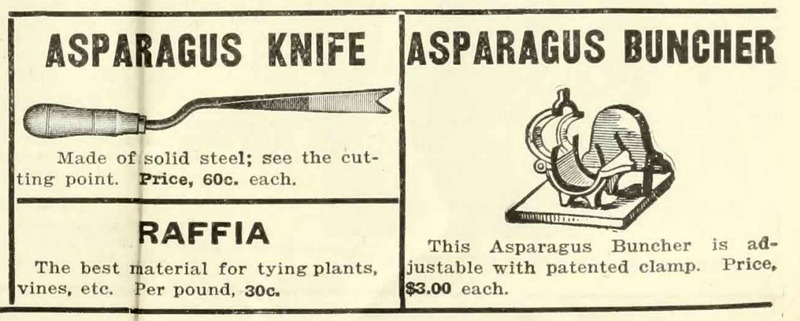
Illustrations of a V-Tip asparagus knife and asparagus buncher from 1920 Griffith's Catalog
Step 2: Barn/Garage Prep
Some years, the customized "Clarence Hahn" 10-foot-long galvanized water tank was placed in the left-hand side of the garage and other years it was in the middle of the truck barn alongside the truck. This tank freshened the assembled, rubber-banded asparagus bundles until boxed and loaded on the truck for market later in the day. Where the tank was determined in which building the baskets from the field were unloaded.
Sharpening [of cutting implements] by Carl, hired hands or relatives except uncles Mike, Bill or George, were never acceptable. Grandpa's knives were sometimes but not usually acceptable.
Rarely did all six baskets get filled on one circuit—this occurs only at the mid-season growth peak and then only if it has been hot and muggy the night before.
Charles' season was nominally 6 weeks, as he liked to let the waning production go to maturity for the benefit of the roots. Other farms were known to harvest for longer periods. I thank God for Charley's devotion to the roots.
About mid-morning, Anna, Doris and June (if available) and in later World War II years, Mrs. Griswold or Mrs. Upson, would begin grading and separating the asparagus into three grades: Fat and Tall stalks, Fat and Short stalks (the ready-for-market grades) and those thin, stringy stalks that were rarely offered for sale. It is these latter thin stalks that one must seek out for this recipe, for as children we were told that these were the choice spears—too valuable to be offered to an unappreciative public.
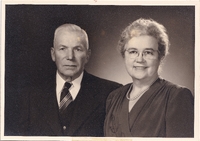
Charles and Anna Zdunek Haushalter
Step 3: Cooking
Divide today's yield of the thin, stringy stalks with the hired man, whoever helped Anna sort and Mr. Hotchkiss if he had made his rounds today.
Have enough boiling water in a skillet to cover the selected quantity of asparagus stalks. Boil gently 7 to 10 minutes. Drain and plate, adding butter, salt and pepper to taste. The kitchen gets four stars.
If Grandpa George helped sort today, there will also be many broken stalks of the fatter grades available for the family meal.
Our Italian neighbors, the Trippes, put some kind of grated cheese (Ptarmigan, Parmajohn?) on theirs, but what could Italians know about cooking, eh?
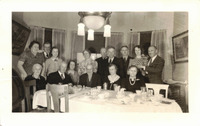
A Haushalter Family Dinner at the Farmhouse in the 1940s
Alert: Those of you who watch Julia's, Jacque's, Emeril's or other TV cooking shows—don't be misled when they insist that the fatter stalks are the tenderest and most flavorful—they are not cooking during a depression.
Haushalter, Carl, Asparagus à la Charles and Anna; Haushalter Family Archive; privately held by Liz Casler Loomans, Cincinnati, Ohio, United States, 2026. Account written by Carl and distributed as printouts to various family members, including his sister, June (Haushalter) Casler, from whom the current owner inherited them.