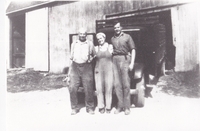
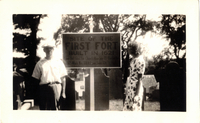
In the summer of 1946, as the shadows of the Second World War began to recede, the Haushalter family stood together before the Stewart Truck and Horse Barn, a testament to the enduring continuity of their fifty-acre farm in Water Valley. Dressed in the heavy denim and functional workwear of the farm—Anna and Carl in sturdy overalls—the trio embodies the grit and resilience required to maintain the land. The image captures a pivotal moment of transition: the intersection of traditional animal husbandry and the burgeoning mechanization of the mid-century American landscape. For the Haushalters, this moment was more than a simple family snapshot; it was a quiet reclamation of normalcy and a reaffirmation of their multi-generational commitment to the soil of Hamburg, New York.
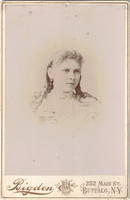
This delicate cabinet card portrait captures a young Ada Gallman (1881–1969) during her childhood in the early 1890s. Taken at the Bigden studio on Main Street in Buffalo, New York, the image reflects the formal portraiture traditions of the late Victorian era. Ada is presented with the soft, romantic styling typical of the period, featuring intricate lace detailing and soft curls. The vignette effect—a popular photographic technique of the time—focuses all attention on her youthful expression, preserving a fleeting moment of her childhood before her later life as a member of the Haushalter family in Eden and Hamburg.
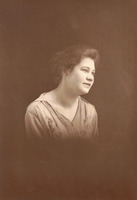
In this profile study, Clara Zdunek (1894–1981) is captured with a soft, gentle and approachable elegance, her mouth slightly open as if about to speak. The Palladium process embeds the image directly into the paper fibers, giving the photograph a tactile depth and a non-reflective, velvety surface. The rich chocolate tones highlight the intricate styling of her hair and the soft, diffused light on her features.
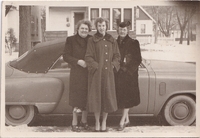
Clara, Doris and Minnie pose for a picture with Doris and Milt's new Studebaker Champion convertible winter c. 1949; snow on ground, women in fur-accented coats; convertible has cloth roof
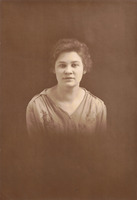
Clara Zdunek emerges from a deep, chocolate-y background in this captivating frontal portrait. This Palladium print is a beautiful example of early 20th-century artisan photography, chosen for its warm, rich tonality. At roughly eighteen, Clara is the image of a new generation. The studio’s choice to strip away all props and focus entirely on her face pulls the viewer into her steady, luminous gaze. The rich brown tones are characteristic of the Palladium process, which favored a depth and warmth that standard silver prints could not achieve. It is a permanent art object, capturing the youngest sister at the exact threshold of her adulthood.
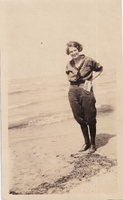
Captured in a moment of spirited physical freedom, Clara Zdunek stands on the Lake Erie shore wearing a nautical "middy" blouse and trousers—a modern ensemble that rejected the restrictive layers of the previous generation. This silver gelatin snapshot is distinguished by a small identification tag hand-labeled "Clara" tucked into her pocket, suggesting the photo was part of a structured group outing or resort activity where individual names were afterwards written on photos. The image captures the "New Woman" aesthetic of the 1910s, where the shore provided a rare stage for young women to inhabit their bodies with strength and joy. It is a candid record of a generational shift toward mobility, documenting the youngest sister's vibrant presence in the sun.
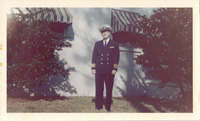
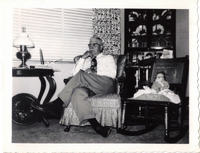
In the bright, dappled light of February 1962, Bernard George Geuting (1912–2005) stands poised in his Navy officer’s uniform. The sharp shadows of garden foliage dance across the white walls of a residence, lending a quiet, domestic stillness to the moment. A career surgeon who served through the decades, Geuting carries himself with the composed dignity of a man seasoned by years of naval service.
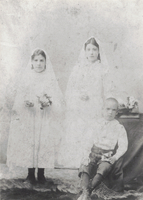
Almost certainly taken in Syracuse, New York, where the family lived starting around 1884, this formal studio portrait captures three children of the Conners family—Johanna, her brother Dennis, and an unidentified sister—dressed in ceremonial attire for their First Holy Communion. Based on the age of Dennis (born c. 1879), the photograph was likely taken in the mid-to-late 1880s. The girls are depicted in traditional white communion dresses and veils, while Dennis sits prominently in the foreground in period-appropriate knickers and boots.
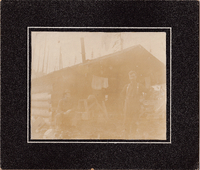
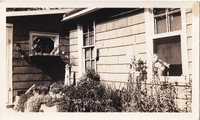
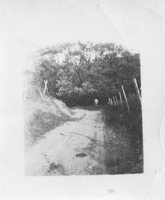
This diminutive snapshot, measuring only 2.5 inches on its longest edge, offers a unique and playful window into the early years of the Haushalter farm in Water Valley. Likely captured in the late 1920s or early 1930s, the image possesses a characteristic "haze" and soft focus, typical of the consumer box cameras used by families during this era. While the photograph itself is an ambiguous view of a farm lane, the inscription on the reverse—"Our Lane -- That white object is a cow -- not me!"—provides a vital temporal and spatial anchor. The note, believed to be a reaction by a young June Haushalter, suggests she was present on the farm during this period, using the photographic ambiguity of the scene to share a moment of humor.
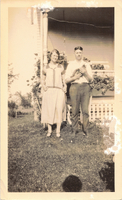
In the gentle light of a mid-1920s afternoon, Wilhelmine "Minnie" Zdunek (1892–1966) and David Roy Thomas (1890–1976) stand before a shaded porch, perhaps in the quiet vicinity of Water Valley. Married in late 1923, the couple radiates a relaxed, domestic contentment. David holds a small cat, which lends a charming, unposed quality to the moment. Minnie’s sleeveless dress with its dark vertical trim and David’s high-waisted trousers are quintessential markers of the era's shifting fashions. This photograph captures a fleeting moment of peace for a young couple just beginning their journey together, anchoring their personal history to the rural landscapes of Erie County during a decade of profound change.
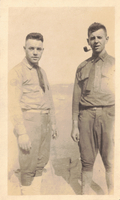
Captured in 1914, this striking portrait features a young David Roy Thomas (right) and a companion, both dressed in what appear to be National Guard or cadet uniforms. The image provides a powerful visual testament to the era of "Preparedness" that preceded the United States' entry into World War I. The subjects exhibit a disciplined uniformity, from their neat, military-style haircuts to their matching attire of collared shirts, neckties, and heavy, structured legwear—likely high-laced boots or puttees. This photograph captures Thomas at a pivotal moment of transition, documenting his early involvement in organized service that would serve as a precursor to his later deployment with the 151st Depot Brigade during the Great War.