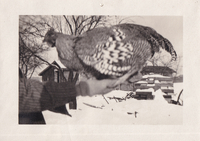
The archive preserves a vivid snapshot of the agricultural pride that defined Hampton Brook Farm in the 1920s. Through the striking, patterned plumage of a Barred Rock rooster and the elegant purple satin of a "Champion Male" ribbon, we see the dual nature of the Haushalter family's success: the tangible quality of their livestock and the formal recognition they earned within the regional poultry community. Whether this specific bird was the one that carried the Flower City Poultry & Pigeon Association award or simply a representative of the high standard maintained on the farm, the items together tell a story of excellence. They capture a moment when the rhythms of the 50-acre farm were measured not just by seasonal harvests, but by the prestige of the prize ribbon and the meticulous stewardship of the land and its creatures.
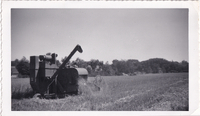
In the mid-1950s, the rhythmic discharge of grain from a Borchert combine marked the height of the harvest season on the Haushalter farm. Positioned on the front acreage, the machine faces the wooded descent of "The Gully"—the natural, deep dip in the landscape that served as the farm's topographical spine, dividing the front acreage from the eastern back acreage. This view captures a moment of mechanical progress set against a landscape defined by its ancient, rugged contours: the wooded hollow where a dirt road once dipped down to cross a modest bridge over a seasonal trickle of water.
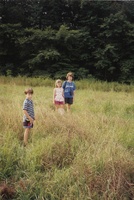
By 1990, the fields have long lain fallow, wild grasses and weeds growing up where crops were once harvested. Two of June Haushalter Casler's grandchildren and her daughter-in-law take a hike through the fields, trying to catch some interesting specimens. Someone doesn't look thrilled with her picture being taken.
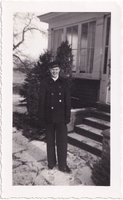
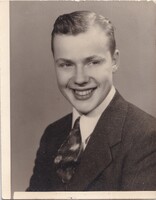
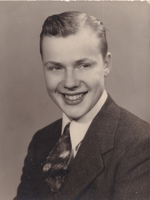
This deckle-edged snapshot, captured in 1943, depicts eighteen-year-old Carl Henry Haushalter during a period of leave from the United States Navy's V-12 College Training Program. Carl is pictured by the back porch of the Haushalter farmhouse in Water Valley, New York. The house, a Sears Catalog kit home, serves as a backdrop that illustrates the presence of standardized American residential architecture in rural Erie County. The image presents a direct contrast between Carl’s formal naval uniform—marking his involvement in the high-stakes technical training required for the war effort—and the domestic familiarity of his family farm.
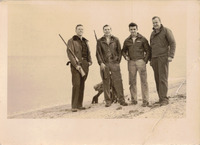
On a flat, sandy shoreline, four men stand in a line, each holding a military rifle. Their heavy flight jackets and the presence of military-issue firearms suggest they are aviation personnel or military members in a coastal setting. On the far right is Carl Haushalter (1925–2012). This image likely captured a moment of camaraderie among pilots or technical crew during their service in the early 1950s.
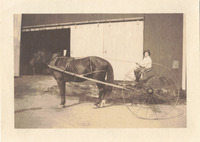
In the heavy heat of July 1921, a young Carl Stunick sits perched atop a horse-drawn hay rake, a small figure amidst the formidable machinery of the Water Valley harvest. This image captures more than just a child at play; it documents a moment of connection between the extended Zdunek family and the fifty acres of land they helped sustain. As the nephew of Anna Zdunek Haushalter, Carl’s presence here underscores the deep, interlocking kinship ties that defined the Haushalter farm's social landscape. Beside him, the horse Dan stands in quiet patience, a silent partner in the seasonal rhythms of labor and life.
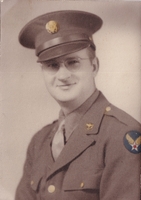
This portrait captures Carl Ellison Stunick, a Staff Sergeant in the United States Army Air Forces (USAAF) during the height of World War II. Taken circa 1942, the image shows Stunick in his service uniform, featuring the distinctive winged star insignia of the USAAF on his shoulder. His attire and the professional studio lighting reflect the common wartime practice of service members commissioning formal portraits to send home to family members. The black and white silver gelatin print has been selectively hand-tinted to highlight Carl's military identity.
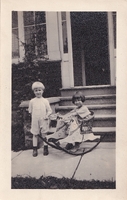
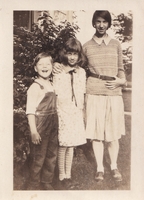
Carl, June and Doris stand in front of shrub by enclosed veranda c. 1930; Carl is in overalls and a shirt, June in dress and long stockings with long ribbon at throat, Doris in skirt, belted sweater, collared shirt
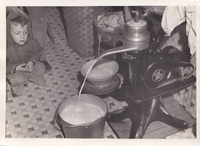
Here, a young Casler crouches on the checkered linoleum of the laundry room, his gaze fixed on the mechanical marvel of the De Laval cream separator. The handwritten note describing his "contemplation of the mysteries" perfectly captures the intersection of childhood wonder and the heavy, cast-iron reality of dairy farming. This is not merely a domestic snapshot, but a portrait of a child being raised amidst the tools of stewardship. As the separator worked to process the farm's output, it provided the backdrop for a generation of the Haushalter-Casler lineage to grow up intimately acquainted with the labor and the machinery that sustained their family's fifty-acre legacy.