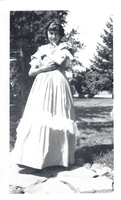
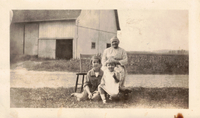
June stands as if dressed for costume event of some sort in wide-skirted dress with ruffle at middle; she has bow in hair and a cat in her arms in the yard of the Haushalter farmhouse c. 1934
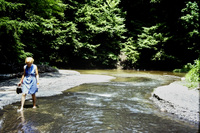
Through the eyes of her son, John Casler (1945– ), we see June Haushalter Casler (1920– 2025) in her element. Standing barefoot in the sun-dappled waters of Hampton Brook, June is framed by the lush, overhanging canopy that has defined the rear of the Haushalter farm (once known as Hampton Brook Farm) for generations. This digital snapshot, captured with a wide-angle view, emphasizes the scale of the Water Valley woods and the deep connection between the woman and the land her family held for over 150 years.
A timeline of the ownership of the Haushalter land and to what use it was put between 1822 and 2003, written seemingly from memory by June Haushalter Casler.
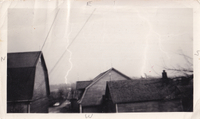
A sudden fracture in the sky, captured in a flash of silver and shadow, this image preserves a moment of raw atmospheric power over the Haushalter farm circa 1937. While the lightning bolts strike with violent brilliance, the farm buildings stand as dark, resolute silhouettes against the electrical upheaval, embodying the stoic presence of the homestead during the late Depression era. The inclusion of cardinal directions etched onto the print edges reveals a desire to map and master the landscape, treating the farm not just as a home, but as a specific, documented territory. Yet, there is a haunting quality to the image when viewed through the lens of the family’s later notes; the very structures that once weathered these storms would eventually succumb to the weight of snow and the slow march of time. This photograph serves as a temporal bridge, linking the vibrant, elemental energy of the 1930s to the quiet, inevitable shifts in the stewardship of these fifty acres.
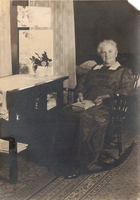
This portrait captures Louisa Sigel Gallman (1855–1949) in her later years, offering a quiet moment of reflection within a domestic setting. Having immigrated from Württemberg, Germany, as a teenager in 1870, Louisa’s life spanned a period of immense transformation in Erie County, New York. Seated in a spindle-back chair beside a lace-covered table, she holds a small book—perhaps a prayer book or a family record—symbolizing the literacy and faith that often anchored the immigrant experience. Her attire, a dignified dark dress accented by a delicate white lace collar, reflects the conservative elegance common among women of her generation.
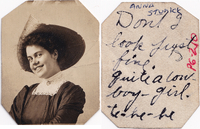
This octagonal portrait of Anna Zdunek hides a sharp wit behind its oversize "Merry Widow" hat. While her dress presents a picture of Edwardian propriety, Anna’s facial expression, body posture, and handwritten note on the reverse—calling herself a "low-boy-girl"—reveal a rebellious spirit and a skepticism of the high-fashion demands of the day. The "te-he-he" scrawled in her hand bridges a century, allowing us to hear the laughter of a woman who refused to be pinned down by expectations. Even under the heaviest millinery, the sisters maintained a vibrant, independent sense of humor that subverted the stiff standards of the era.
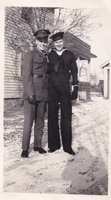
This picture captures Mack Robinson and Carl Haushalter on leave in 1943. Having previously worked together performing the intensive manual labor required by the Haushalter truck farm in Water Valley, New York, the two are pictured here in their respective military uniforms. Robinson stands on the left in a United States Army Service Uniform, while Haushalter, on the right, wears the United States Navy service dress. The photograph, taken outdoors against the siding of the Haushalter farmhouse, likely during the winter or early spring, serves as a visual record of the shift from rural agricultural life to the global mobilization of World War II. It documents the shared history of two friends whose lives were redirected from the agricultural fields of Erie County to the service of their country.
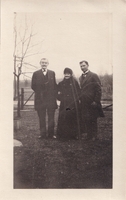
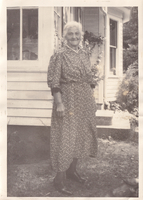
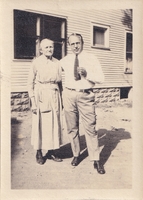
Mary Heinrich Haushalter, with eyes mostly shut as if she may by now be blind, standing with son Fred Haushalter outside unknown house c. 1920; Mary in loose dress with collar, Fred in suit and tie with cigar in one hand and other arm around his mother
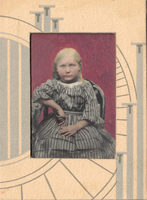
This hand-tinted version of Mary Heinrich’s portrait reveals the artistry of the 19th-century photographic studio. By applying delicate washes of color to the skin tones and a rich, textured pigment to the background, the photographer has transformed a standard carte de visite into a unique work of art. The deep, dramatic hues of the background create a striking contrast, drawing the viewer's eye directly to Mary's youthful expression. This colorization represents a moment in history when photography was transitioning from a purely scientific process into an expressive art form, used by families to create lifelike, cherished keepsakes that felt more 'real' than the silver-toned prints of the time.
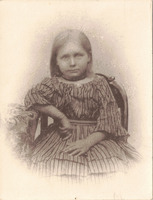
This carte de visite captures a young Mary Heinrich (1853–1926) during her childhood, likely in the mid-1860s. Born in Eden, New York, to Jean-George Heinrich and Salome Wohlhuter, Mary was a member of the prominent Heinrich family, another foundational lineage of the Water Valley area. This portrait captures her in the striped dress and simple hairstyle typical of the mid-Victorian era, years before she would marry George 'Henry' Haushalter in 1877. This image serves as a poignant visual record of the era when these families were establishing the social and agricultural fabric of Erie County, documenting a life that began in Eden and eventually helped shape the legacy of the Haushalter farm for generations to come.
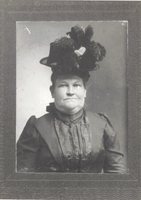
In this studio portrait, Mary Melissa Goodell (1846–1910) embraces the bold fashion of the Edwardian era. Moving away from the more seated poses common in earlier decades, this image showcases the era's penchant for dramatic millinery; Melissa wears an expansive, feathered hat that serves as the portrait's focal point. The elaborate headwear and structured bodice reflect the sophisticated aesthetic of the early 1900s, a period when fashion emphasized grandeur and silhouette. This photograph provides a vibrant glimpse into the personal style of a woman in her later years, as she approached the end of her life in 1910.
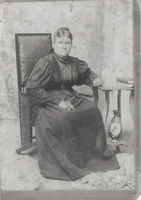
This formal studio portrait captures Mary Melissa Goodell Casler (1846–1910) in the twilight of her life, likely taken in the first decade of the 20th century. Seated with a composed and dignified air, Melissa wears the fashionable attire of the late Victorian or early Edwardian era, characterized by a dark, structured bodice and a high, lace-trimmed collar. The studio setting—complete with a heavy, studded armchair, a decorative vase, and books—was designed to project an image of respectability, intellect, and middle-class stability. As a matriarch of the Casler family, this image serves as a visual record of a woman who lived through much of the 19th century, bridging the gap between the early settlement eras of New York and the dawn of the modern age.
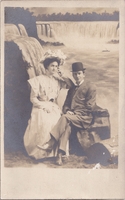
Amidst the mist and grandeur of Niagara Falls, Olive Branch Melvina Swain (1889–1951) and Michael Friedrich Wilhelm Zdunek (1889– 1961) paused to capture a moment of romantic permanence. Likely taken during their wedding travels in 1912, this postcard shows Olive draped in the soft, ethereal textures characteristic of the era, her light-colored ensemble accented by a delicate, voluminous floral headpiece that lends an air of bridal grace to her repose. While the men of the period, like Michael in his formal top hat and dark suit, maintained a rigid and structured sartorial standard, women’s fashion was beginning to embrace a more romantic, fluid elegance. This image preserves the intersection of a young couple's private joy and the sweeping, idealized aesthetics of early American tourism.
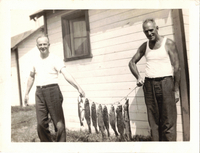
Michael on the left and Al on the right each hold one end of a string of fish they have presumably caught in front of a small white shed or cottage with one window, c. late 1930s
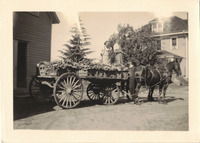
During summer in the 1930s, the Haushalter farm was a landscape of rhythmic, heavy labor, a reality captured here in a moment of shared productivity. Michael Stunick—brother to Anna Zdunek Haushalter—and Robert "Bob" Van Allen, a friend and neighbor, stand together in the bed of a heavily laden wagon, surrounded by the leafy bounty of the season. This image, preserved through the keen, observant notes of Carl Haushalter, records more than just a harvest; it captures the very bones of the farmstead, from the original wooden steps of the farmhouse to the sheltering tree by the cellar entrance.