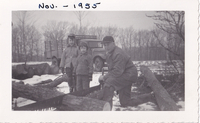
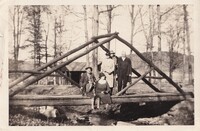
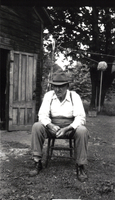
As Charlie Haushalter leans over the timber in the Water Valley woodlot, he is wielding more than just a tool; he is wielding a piece of his own history. The two-man logging saw he uses is the very same one that carried him through the rugged logging camps of Idaho at the turn of the century. Having returned to the family farm in 1907 to rescue the farm from the brink of ruin, Charlie brought the hard-won skills of the West back to the soil of New York, carrying with him the quiet regret of the life he had left behind in the Idaho woods. For his grandchildren, this moment of "observing" might serve as a silent lesson in resilience. Through the rhythmic, heavy pull of that old saw, the family's past sacrifices and their enduring commitment to the fifty-acre farm are made tangible, bridging a lifetime of labor and a landscape of shifting identities.
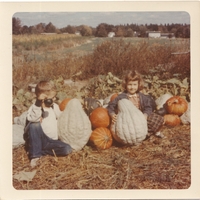
While the adults of the Haushalter adults approached the harvest with the focused intent of competitors, the children experienced it as a landscape of play and wonder. In this candid moment from circa 1960, twof of Charles Haushalter's grandchildren are nestled among the very same prize-winning squash destined for the Erie County Fair. The massive, pale gourds and sun-colored golden delicious squash seem almost larger than the children themselves, creating a scene where the bounty of the land serves as both a playground and a backdrop for a rising generation.
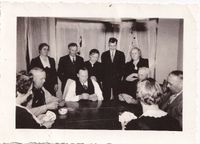
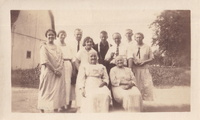
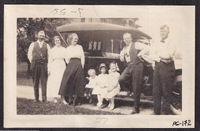
From left to right, Anna Stunick Haushalter, Lydia Pfitzinger Haushalter, William Haushalter, ?, Ada Gallman Haushalter, George Haushalter, Fred Haushalter, Jack Geuting and Louise Haushalter Geuting; seated, Louise Gallman and Mary Louise Heinrich Haushalter; family photo c. 1917; in farmyard by barn, spring or summer
Doris Haushalter and two other children sit on running board of Bill Haushalter's 1920 Dodge with Charles and Anna Haushalter and Minnie Stunick standing left, William and Walter Haushalter right c. early 1920s
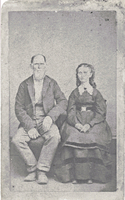
This portrait, a reproduction of a late 19th-century studio photograph, captures Henry Casler (1811–1886) alongside a young woman identified in family records as Edith, a daughter of his second wife. Henry, appearing in his senior years, is dressed in formal period attire, including a dark jacket and waistcoat. Beside him, "Edith" wears a dark dress featuring a wide, decorative lace collar, a fashion highly characteristic of the mid-to-late 1870s. While the archival label identifies the female subject as 'Edith (daughter of 2nd wife),' genealogical research and census records indicate that Henry Casler's only daughter from his second marriage (to Elizabeth Ann Van Ever) was Lydia J. Casler (1851–1928). The name 'Edith' is likely a transcription error or misidentification by a later family member.
This youthful bust-length portrait captures Joseph Andrew Casler (1875–1962) in his early adulthood, likely during the late 1890s. The image utilizes a soft vignette style, a popular photographic technique of the era that focuses all attention on the subject's face by allowing the edges of the portrait to fade into the background. Joseph is dressed in the formal attire of a young gentleman, featuring a high, stiff collar and a dark waistcoat. While the photographic style and lighting are strikingly similar to the later portraits of his parents, Melissa and George, the subject's youthful appearance suggests this sitting occurred several years before the family's later studio visits.
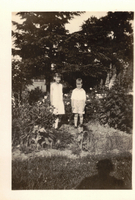
June and Carl stand in a bed of flowers during the summer in front of a stand of trees c. 1930; June is in a light sleeveless dress, Carl in shorts, a white shirt and tall socks
June holds a cat in her arms while Carl is turned toward her, hands also on the cat; Prospect Lawn Cemetery in Hamburg can be seen in the far distance; Haushalter farm c. 1930, spring since the fields are plowed but bare
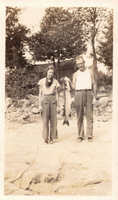
June and Al stand with a caught fish held by Al between them; June has on trousers, a short-sleeve blouse and scarf or bandana around her neck, c. 1938