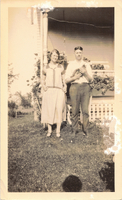
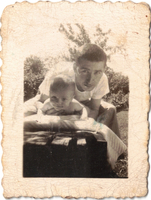
In the gentle light of a mid-1920s afternoon, Wilhelmine "Minnie" Zdunek (1892–1966) and David Roy Thomas (1890–1976) stand before a shaded porch, perhaps in the quiet vicinity of Water Valley. Married in late 1923, the couple radiates a relaxed, domestic contentment. David holds a small cat, which lends a charming, unposed quality to the moment. Minnie’s sleeveless dress with its dark vertical trim and David’s high-waisted trousers are quintessential markers of the era's shifting fashions. This photograph captures a fleeting moment of peace for a young couple just beginning their journey together, anchoring their personal history to the rural landscapes of Erie County during a decade of profound change.
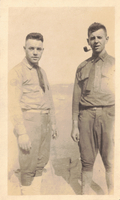
Captured in 1914, this striking portrait features a young David Roy Thomas (right) and a companion, both dressed in what appear to be National Guard or cadet uniforms. The image provides a powerful visual testament to the era of "Preparedness" that preceded the United States' entry into World War I. The subjects exhibit a disciplined uniformity, from their neat, military-style haircuts to their matching attire of collared shirts, neckties, and heavy, structured legwear—likely high-laced boots or puttees. This photograph captures Thomas at a pivotal moment of transition, documenting his early involvement in organized service that would serve as a precursor to his later deployment with the 151st Depot Brigade during the Great War.
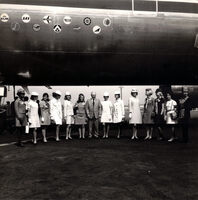
At the 1971 Paris Air Show, the gleaming fuselage of a McDonnell Douglas jet serves as a backdrop to the era's international reach. A row of stewardesses, dressed in the sharp, mod silhouettes of the early seventies, stands poised alongside a corporate representative. This moment captures the intersection of heavy industry and the burgeoning glamour of global travel. While the man remains unidentified, his presence links the technical precision of McDonnell Douglas to the human elegance of the flight crews who operated these machines. The airline logos—KLM, SAS, and UTA—painted across the metal skin of the aircraft, represent a world increasingly connected by the very engineering the Haushalter family witnessed through their professional ties, turning the tarmac at Le Bourget into a stage for the modern age.
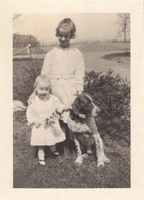
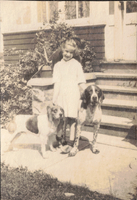
Doris stands with her arm on June's shoulder, June with spring of flowers in hand and other hand on Rex's back near the drive on the Haushalter farm, c. 1921
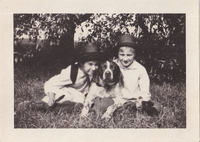
Doris leans into Rex, a black and white dog, with Carl Stunick on the other side, all in front of apple tree on Haushalter farm, July 1921; both kids in rounded-top hats and white clothes
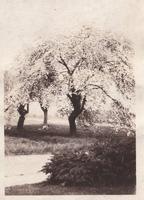
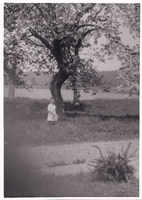
Doris standsin distance by a very old apple tree on the Haushalter farm by the drive in a dress with bow in hair c. early 1920s; she's holding an unknown object
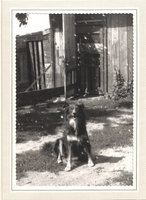
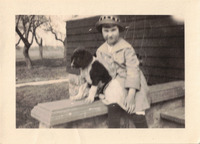
Doris in coat and hat with black and white dog on Haushalter farmhouse steps c. 1922; she wears a coat over a white dress with black stockings, a round hat with striped ribbon on her head
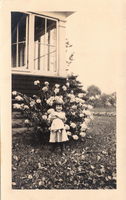
Doris Haushalter standing next to side of enclosed Haushalter farmhouse porch, summer c. 1918; she has a doll in her arms and is standing in front of a flowering shrub
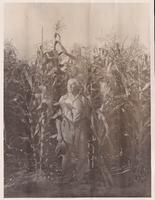
Standing amidst the towering stalks of a Water Valley cornfield, Charles Haushalter (1880–1963) in his seventies possesses a sturdy presence amidst the crop he has spent a season tending. The mature corn, heavy with tassels, marks the height of the growing season—a moment of seasonal culmination.
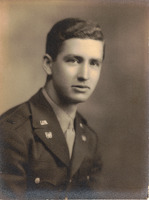
In this studio portrait, Edwin Charles Casler (1918–2007) wears the uniform of the U.S. Army Air Corps, a sharp departure from his days playing infield for the Albany State Teachers' College baseball team. The soft-focus lighting captures a young man poised between the sounds of the Minoa railroads and the responsibilities of a warrant officer. It is a moment of stillness before a life defined by service.
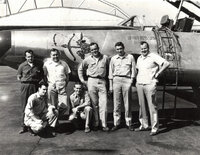
The dawn of the Cold War demanded a new kind of warfare: one fought not just with speed, but with electronic precision. Standing beside the Lockheed F-94 Starfire (Serial No. 50 918), Carl Haushalter (1880–1963) is at the center of this revolution. As an all-weather interceptor, the F-94’s success depended entirely on the sophisticated radar systems that allowed it to hunt through clouds and darkness. For a leading radar expert like Carl, this aircraft was a high-stakes laboratory where engineers and pilots worked in tandem to bridge the gap between electronic data and human reflex. Amidst the utilitarian workwear of the crew and the striking Native American nose art, this image captures the moment human ingenuity began to master the invisible waves of radar to secure the skies.