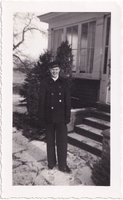
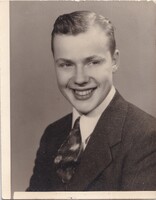
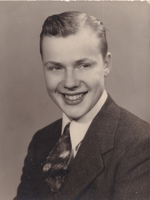
This deckle-edged snapshot, captured in 1943, depicts eighteen-year-old Carl Henry Haushalter during a period of leave from the United States Navy's V-12 College Training Program. Carl is pictured by the back porch of the Haushalter farmhouse in Water Valley, New York. The house, a Sears Catalog kit home, serves as a backdrop that illustrates the presence of standardized American residential architecture in rural Erie County. The image presents a direct contrast between Carl’s formal naval uniform—marking his involvement in the high-stakes technical training required for the war effort—and the domestic familiarity of his family farm.
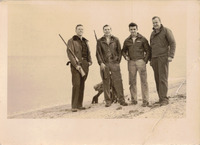
On a flat, sandy shoreline, four men stand in a line, each holding a military rifle. Their heavy flight jackets and the presence of military-issue firearms suggest they are aviation personnel or military members in a coastal setting. On the far right is Carl Haushalter (1925–2012). This image likely captured a moment of camaraderie among pilots or technical crew during their service in the early 1950s.
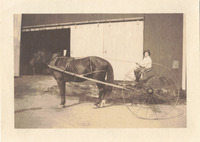
In the heavy heat of July 1921, a young Carl Stunick sits perched atop a horse-drawn hay rake, a small figure amidst the formidable machinery of the Water Valley harvest. This image captures more than just a child at play; it documents a moment of connection between the extended Zdunek family and the fifty acres of land they helped sustain. As the nephew of Anna Zdunek Haushalter, Carl’s presence here underscores the deep, interlocking kinship ties that defined the Haushalter farm's social landscape. Beside him, the horse Dan stands in quiet patience, a silent partner in the seasonal rhythms of labor and life.
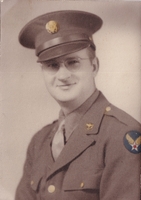
This portrait captures Carl Ellison Stunick, a Staff Sergeant in the United States Army Air Forces (USAAF) during the height of World War II. Taken circa 1942, the image shows Stunick in his service uniform, featuring the distinctive winged star insignia of the USAAF on his shoulder. His attire and the professional studio lighting reflect the common wartime practice of service members commissioning formal portraits to send home to family members. The black and white silver gelatin print has been selectively hand-tinted to highlight Carl's military identity.
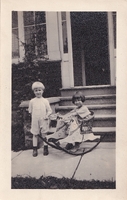
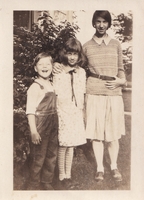
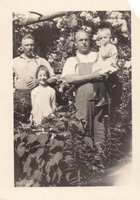
Carl, June and Doris stand in front of shrub by enclosed veranda c. 1930; Carl is in overalls and a shirt, June in dress and long stockings with long ribbon at throat, Doris in skirt, belted sweater, collared shirt
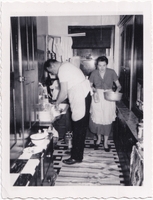
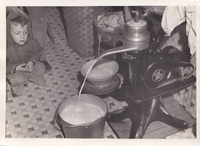
Here, a young Casler crouches on the checkered linoleum of the laundry room, his gaze fixed on the mechanical marvel of the De Laval cream separator. The handwritten note describing his "contemplation of the mysteries" perfectly captures the intersection of childhood wonder and the heavy, cast-iron reality of dairy farming. This is not merely a domestic snapshot, but a portrait of a child being raised amidst the tools of stewardship. As the separator worked to process the farm's output, it provided the backdrop for a generation of the Haushalter-Casler lineage to grow up intimately acquainted with the labor and the machinery that sustained their family's fifty-acre legacy.
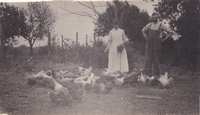
This candid snapshot, captured circa 1915, offers an intimate glimpse into the daily life and agricultural pride of Charles Heinrich Haushalter and Anna Louise Zdunek on their 50-acre farm in Water Valley. This image depicts the couple in their element: the chicken yard. The presence of the Plymouth and Barred Rock chickens is particularly significant; these breeds were not merely livestock but a point of professional distinction for Charles, who would go on to earn various county and state fair awards for them in the years following this photograph. The image captures a moment of domestic industry, illustrating the close relationship between the Haushalter family and the land they would steward for generations.
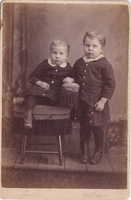
This formal portrait captures brothers Charles (left) and William (right) Haushalter around 1884–1886. Likely standing in a studio in the Hamburg or Buffalo area, the boys are dressed in the peak formal attire of the era: matching heavy wool tunics, metallic buttons, and stiff, scratchy white lace collars. Because albumen prints of the 1880s still demanded long, unblinking exposure times, both brothers wear the characteristically intense, deadpan expressions of children commanded to freeze under a photographer’s strict glare.
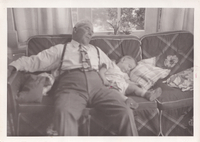
Charles and grandson John have fallen asleep sitting together on the farmhouse porch glider while listening to the family Victrola play "Marching through Georgia", c. 1947
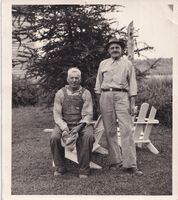
Charles sits on arm of adirondack chair, Mr. Reichert standing to right; Charles hat in hand, Reichert on head; back yard of Haushalter farmhouse c. 1946