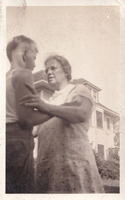
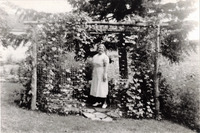
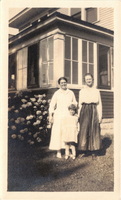
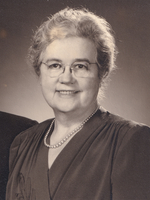
Anna Zdunek Haushalter (1885–1959) finds a moment of repose in the farmhouse yard. Framed by a rustic arbor draped in thick, climbing vines, she stands in a pocket of shade that feels both private and deeply connected to the surrounding fifty acres. The scene, likely captured in the 1950s, highlights the domestic side of farm life—the quiet beauty of a well-tended garden amidst the seasonal rhythms of Hamburg, New York.
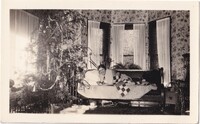
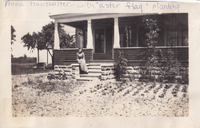
Anna Stunick Haushalter as a young woman sitting on front steps of home on Gowanda State Rd in Water Valley, Hamburg, NY where she lived with her husband Charles; garden planted in shape of American flag in foreground
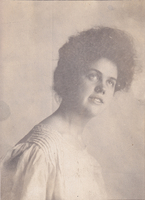
In this soft-focus portrait, we encounter Anna Zdunek (1885 – 1959) in the bloom of her young adulthood. While the exact year of this sitting is lost to time, the elegance of her swept-up hair and the delicate pleats of her bodice evoke the atmosphere of the early 1900s. The image possesses a dreamlike, ethereal quality, capturing a sense of poise and quiet transition. Because the print was later repurposed as a homemade postcard, we see evidence of how this image functioned within the family—not as a distant, formal relic, but as a cherished, portable keepsake.
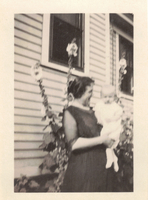
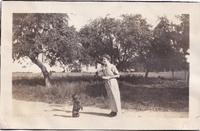
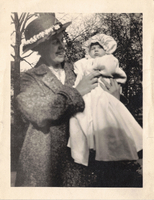
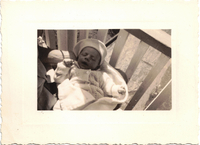
Anna Stunick Haushalter in coat and hat outside in front of bare trees holding Doris Haushalter in baby gown and bonnet; note on back that Doris is 2 months and 16 days old
Anna and Charles' Wedding book from their 1912 Buffalo, New York wedding was a mass-produced, loosely-bound book published by the Reverend Salem D. Towne in 1895. The book contains the wedding ceremony, as well as a souvenir version of the marriage certificate, which has been filled out.
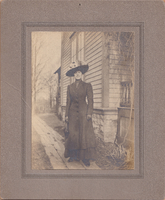
On a crisp November day in 1910, Anna Zdunek (1885 – 1959) stands before the camera not merely as a subject, but as a master of her craft. This mounted print serves as a visual portfolio, capturing Anna in her "latest creation"—a meticulously tailored ensemble that speaks to the sophisticated sartorial standards of Buffalo at the turn of the century. From the disciplined line of the buttoned bodice to the dramatic sweep of her ornamental hat, the photograph documents the professional identity Anna cultivated as a dressmaker and milliner. It is a portrait of a woman in her urban prime, possessing a quiet confidence and a keen eye for form.
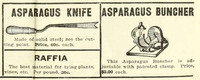
A cropped detail of illustrations of an asparagus knife and asparagus buncher from a page of the 1920 Griffith and turner Co. Farm and Garden Supplies Catalog
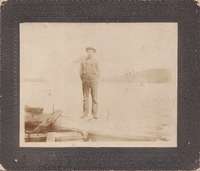
Unlike the polished studio portraits of the era, this image captures Charles Heinrich Haushalter (1880–1963) in his true element: the rugged periphery of the Idaho wilderness. Standing at the terminus of a logging road near the shores of Lake Coeur d'Alene, Charles wears the practical uniform of a woodsman—sturdy trousers, suspenders, and a wide-brimmed hat. The photograph carries a profound sense of place, anchored by family lore that identifies this exact spot through the memory of a friend. It serves as a visual testament to the years Charles spent navigating the timberlands of the West before the call of the family farm in New York brought him home.
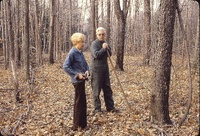
In the waning light of the late 1970s, June Haushalter Casler (1920–2025) and Edwin Casler (1918–2007) stand amidst the quiet woods of the family farm in Water Valley. The ground is thick with the copper-colored leaves of autumn. Ed, leaning on a thick walking stick, and June, in a sturdy denim jacket, share a moment of quiet companionship. This image captures a period long before the eventual subdivision of the land in the early 2000s.
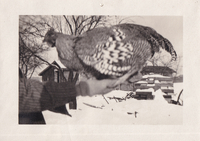
The archive preserves a vivid snapshot of the agricultural pride that defined Hampton Brook Farm in the 1920s. Through the striking, patterned plumage of a Barred Rock rooster and the elegant purple satin of a "Champion Male" ribbon, we see the dual nature of the Haushalter family's success: the tangible quality of their livestock and the formal recognition they earned within the regional poultry community. Whether this specific bird was the one that carried the Flower City Poultry & Pigeon Association award or simply a representative of the high standard maintained on the farm, the items together tell a story of excellence. They capture a moment when the rhythms of the 50-acre farm were measured not just by seasonal harvests, but by the prestige of the prize ribbon and the meticulous stewardship of the land and its creatures.
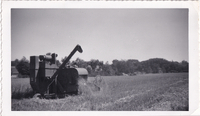
In the mid-1950s, the rhythmic discharge of grain from a Borchert combine marked the height of the harvest season on the Haushalter farm. Positioned on the front acreage, the machine faces the wooded descent of "The Gully"—the natural, deep dip in the landscape that served as the farm's topographical spine, dividing the front acreage from the eastern back acreage. This view captures a moment of mechanical progress set against a landscape defined by its ancient, rugged contours: the wooded hollow where a dirt road once dipped down to cross a modest bridge over a seasonal trickle of water.
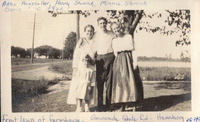
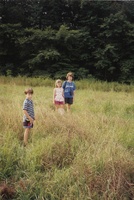
By 1990, the fields have long lain fallow, wild grasses and weeds growing up where crops were once harvested. Two of June Haushalter Casler's grandchildren and her daughter-in-law take a hike through the fields, trying to catch some interesting specimens. Someone doesn't look thrilled with her picture being taken.