

Items
-
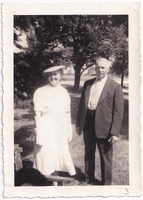
Their Sunday Best Aug 1938
In the late summer of 1938, Anna Louise Zdunek Haushalter (1885–1959) and Charles Heinrich Haushalter (1880–1963) stand in the front yard of the family farm in Water Valley, New York. Dressed in their finest—Anna in a bright summer dress and wide-brimmed hat, and Charles in a formal suit—they pose against the backdrop of the lush trees that shaded their land. Looking toward the home of the previous generation, the couple embodies the quiet dignity and continuity of a family deeply rooted in the soil of Erie County. -
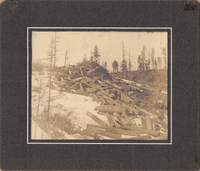
Timber of the Panhandle c. 1905
In the biting chill of the Idaho Panhandle, the scale of the American frontier is measured in timber. This photograph captures a massive accumulation of felled logs, likely a staging area in the Coeur d'Alene region during the early 1900s. For a young Charles Haushalter (1880–1963), these years spent in the logging camps represented a period of grueling physical endurance and seasonal rhythms dictated by the snow and the saw. The sheer volume of the timber, resting heavily against the winter landscape, speaks to the industrial hunger of a nation expanding westward. -

Tintype of Three Women c. 1897
This tintype captures a moment of quiet dignity during the late 1890s, featuring three women likely belonging to the Haushalter or Casler family lineages. The central figure, identified by family records as "Aunt Ada" (Ada Gallman, 1881–1969), appears to be in her late teens, embodying the fashion of the era with her high-collared blouse and decorative, floral-adorned hat. The structured silhouettes and heavy fabrics of their dresses reflect the formal photographic traditions of the late Victorian period, a time when a studio portrait was a significant and intentional family event. -
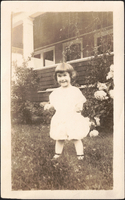
Toddler Doris Haushalter in Farmhouse Yard, June 1915
Doris as a toddler, 17 months according to the back of the photo; flowers in mid-ground are appropriate for June; Haushalter farmhouse in background -
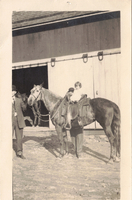
Toddler Doris Haushalter on Horseback c. 1916
Doris Haushalter as a toddler on a brown horse in front of the open doors of the horse barn on the Haushalter farm, two men standing by and another horse behind in the barn door, c. 1916 -

Tools of the Trade: Foreign Material Exploitation
This photograph is a primary artifact of Carl Henry Haushalter’s (1925–2012) professional career in Foreign Material Exploitation (FME). Captured by the Foreign Technology Division (AFSC), the image depicts a Soviet Soyuz spacecraft on display at an international aerospace exhibition. While the "UNCLASSIFIED" stamp allowed for broader distribution, the image served a critical intelligence purpose: providing the visual data necessary for technical analysis of Soviet aerospace capabilities. For Carl, an expert in guidance and RF systems, such images were the very essence of his work. This print represents the intersection of his highly specialized technical expertise and the global high-stakes competition of the Space Race, bridging the gap between the quiet life on the Haushalter farm and the cutting edge of Cold War intelligence. -
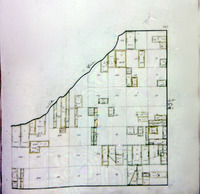
Township 9, Range 8
Original allotment map of the 9th Township, 8th Range as identified by the Holland Land Company -
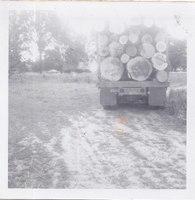
Truck with Logs on Haushalter Farm c. 1950s
In the 1950s, the harvest of a 54-inch diameter Black Walnut served as a practical application of the forest management practices maintained on the Haushalter farm. This was not a random clearing of land, but a calculated part of the property's stewardship, informed by Charlie Haushalter’s formative years working in the logging camps of Idaho. By monitoring the wooded sections of the 50-acre acreage and harvesting timber according to established best practices, the family integrated forestry into their broader agricultural management. This image captures the result of that informed approach: the systematic management of a long-standing natural resource. -
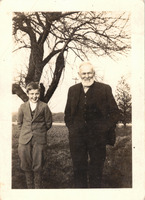
Two Gentlemen Farmers c. 1933
George Heinrich Haushalter (1853–1944), a prominent figure in the Hamburg community known for his progressive agricultural methods and his service as the local postmaster, is depicted in his later years. His dark suit and white beard lend him a dignified, patriarchal presence. Beside him, Carl Haushalter (1925–2012) provides a spirited contrast; his smile and attire—specifically the knickerbockers—are characteristic of a young boy in the early-to-mid 20th century. The natural, soft lighting and the unposed composition suggest this was a personal family snapshot. -

Unidentified Boy on Sidewalk c. 1924
A boy of perhaps five or six years stands on a winter sidewalk in front of what appears to be a shop. He has on a dark, tight cap on his head, leather boots that rise above his ankles, trousers with dark cuffs and a belted wool coat. A dark tie and wide white collar cover the neckline of the coat. Date based on this 1924 Ford ad: witness2fashion.wordpress.com/wp-content/uploads/2014/03/1924-feb-ford-ad-p-59-kids-leggings.jpg -
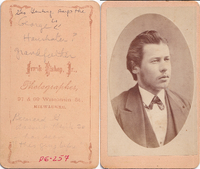
Unknown Cabinet Card Subject by Frank Bishop, Jr. c. 1880s
This albumen print, mounted as a Cabinet Card, features a formal oval vignette portrait of a young man with dark hair and a mustache. The subject is dressed in the fashionable attire of the early 1880s, including a dark suit, waistcoat, and a patterned necktie. The verso of the card identifies the photographer as Frank Bishop, Jr., who operated a studio at 97 & 99 Wisconsin Street in Milwaukee, Wisconsin. While the portrait is part of the Haushalter-Casler archive, the subject's identity remains a subject of genealogical inquiry; handwritten notations on the mount suggest a possible connection to George Haushalter, though this remains unverified. -
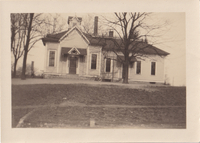
Water Valley School
The schoolhouse on dirt road with bare trees, a bike leaning against the front -
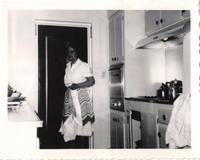
Wilhelmina Stunick in Florida Kitchen c. 1950s
Minnie stands in doorway, tea towel in hand in her Florida kitchen -

Wilhelmina Stunick Rowley Studio Portrait c. 1910
In this profile portrait from the Rowley Studio, Minnie Zdunek wears her pince-nez glasses as a badge of her literacy and modern intellect. This print uses a classic Edwardian silhouette to emphasize her sharp features and the refined "S-curve" of her posture. In an era when women were increasingly claiming space in the professional sphere, Minnie’s choice to be photographed in her spectacles is a deliberate statement of a focused and capable spirit. -

Wilhelmina Stunick Studio Portrait, 1916
By 1916, the world was at war, but in this serene portrait by the Kramer Studio, Minnie Zdunek (1892–1985) remains a pillar of stability. This appears to be a Palladium print—prized for its soft, luminous grays. This image is embedded directly in the paper fibers and shows no cracking. Inscribed "Greetings! Aunt Minnie To Karl," the photograph served as a vital link between the sisters and the next generation, ensuring that even in a changing world, the faces of "The Fifty Acres" would never be forgotten. -
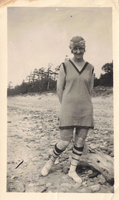
Wilhelmina Zdunek in Bathing Costume c. 1918
On the rocky shores of Lake Erie, near Angola on the Lake, Wilhelmine "Minnie" Zdunek (1892–1966) enjoys a moment of seaside leisure. Captured around 1918 at Pine Lodge, Minnie wears the era's characteristic bathing attire—a tunic over bloomers paired with playful, striped stockings. It is a snapshot of a woman in her prime, embracing the burgeoning culture of American recreation. We see not just a relative, but a living person enjoying the simple, sun-drenched joys of a summer day by the water. -
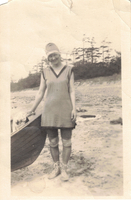
Wilhelmina Zdunek in Bathing Costume with Boat c. 1920
Minnie Zdunek stands with hand on bow of rowboat at beach waterline near Pine Lodge in Angola, NY c. 1920; she wears a skirted bathing costume and matching cap trimmed with a band of a different color, as well as socks and shoes -
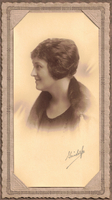
Wilhelmina Zdunek Thomas Wedding Portrait 1923
A study in silhouette and style, this profile portrait of Wilhelmine "Minnie" Zdunek (1892–1966) highlights the sophisticated aesthetics of the 1920s. Photographed by Geisdorfer in Buffalo, the image emphasizes the elegant curves of Minnie's finger-waved hair and the tactile richness of her fur collar. By capturing her in profile, the photographer leans into the Pictorialist tradition, focusing on line and atmosphere. The soft, matte depth of the print captures Minnie in a moment of quiet, feminine poise during the prime of her youth. -
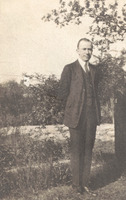
William Kalla by Tree c. 1917
William Kalla stands outside, middle-aged in suit and tie c. 1917 -
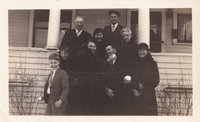
Winter Levity in LaSalle 1937
In the biting chill of a LaSalle winter, 1937, the gravity of family loss is momentarily eclipsed by the simple joy of a snowball fight. Gathered on a porch, several generations of the Zdunek and Stunick kin find a moment of levity. From the elder Augustus Carl Ludwig (1867–1938) to the youthful Carl Haushalter (1925–2012), the image captures a rare, unposed spontaneity. Anna Louise Haushalter (1885–1959), Michael Stunick (1889–1961), and Clarice Liddle (1894–1968) stand amidst the laughter, alongside Frances Warder Swain (c. 1870–post 1930), a testament to the enduring bonds that anchored the family. It is a snapshot of resilience, where even in the depths of winter and mourning, the warmth of kinship prevails. -
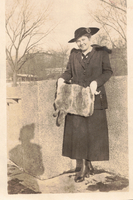
Winter Sophistication: Clarice Auguste Zdunek in Niagara Falls c. 1912
This image brings a transition from the light, airy fabrics of summer to the structured, tactile elegance of the winter season. In this c. 1912 portrait, Clarice Auguste Zdunek (1894 – 1968) stands as a striking example of Edwardian winter fashion. Set against the stark, leafless backdrop of a Niagara Falls landscape, Clarice is wrapped in the heavy textures of the era: a dark, tailored coat, a structured hat, and the quintessential accessory of the age, a plush fur muff. There is a sense of composed resilience in her stance, capturing a young woman navigating the biting chill of a New York winter with grace and style. -
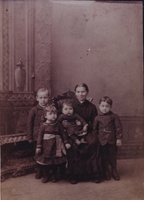
Zdunek Family Mother and Children Studio Portrait c. 1888
This reproduction of a late-Victorian portrait, dating to approximately 1888, serves as a striking study of the era's formal domestic attire. Augusta Lodwig Stunick (1853–1927) is depicted in the dignified, high-collared silhouette characteristic of the late 1880s, her dark, structured bodice projecting an air of maternal authority and Victorian modesty. The heavy, light-absorbing fabrics—likely wool or silk—were essential for achieving the sharp, formal lines required in professional studio photography of the period. Beside her, the children's clothing highlights the era's approach to childhood formality: Anna (1885-1959) wears a patterned pinafore over a dark dress, a classic blend of utility and decoration, while the boys (Charles [1882–1910], Henry [1887–1919] and John [1883–1961])are outfitted in miniature versions of adult masculine tailoring, featuring structured jackets and high-buttoned fronts. -

Zdunek Girls and Friends Group Photo c. 1907
In the soft, dappled light of Angola, New York, circa 1907, a group of women gathers for a portrait that captures a quiet moment of transition in both fashion and family history. We see this evolution in the varied textures of their attire: from the disciplined, somber black dress worn by Clara Zdunek (1894–1968) to the rhythmic, checked pattern of Minnie Zdunek's (1892–1966) dress. High, lace-trimmed collars and the voluminous, swept-up hairstyles of the era frame faces that belong to a community rooted in the evolving landscape of Erie County. Among them sits Anna Zdunek (1885–1959), who in five years would marry Charles Haushalter. Olive Branch Swain (1889–1951) would become Anna's sister-in-law after marrying her brother, Michael Zdunek (1889–1961). Hattie Misfelder (1887–1966) was a cousin of the Zdunek girls on their father's side.