

Items
-

Portrait of Captain Bernard Geuting in US Navy Uniform c. 1945–1960
This formal portrait captures Captain Bernard George Geuting (1912–2005) in his United States Navy Service Dress Blue uniform. A native of Hamburg, New York, Geuting’s life was deeply intertwined with the Erie County community, even as his professional duties took him across the globe. The "scrambled eggs" on his combination cap visor and the array of service ribbons on his chest denote a high-ranking officer who served through the pivotal years of World War II and into the early Cold War era. -

Postcard from Anna Stunick to Charles Stunick in Idaho, 15 July 1908
Front and back of a picture postcard with a postal stamp reading, "Angola Jul 15 1908 5PM". It is addressed to "Mr. Chas. Stunick c/o Wasatch Orchard Co. Ogden, Utah". The body of the message reads, "Hello Bud— Am out camping with Christgaus for a week—such great times as we are having. Wish you were here to join in. With love Anna The front of the card shows several platformed tents lined up on the shore of a creek, with people standing and sitting around the area, which is heavily wooded. The caption reads, "Angola, N.Y. Tents Along the Creek, Bennett Homestead." -
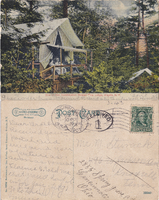
Postcard, Minnie Stunick to Michael Stunick, 1 Oct 1907
Picture postcard of cabin tent at Angola, NY campground; sent from Minnie Stunick to her brother Michael; originally addressed to him in Knoxville, then readdressed to Cincinnati where it was postmarked on Oct 1, 1907 -
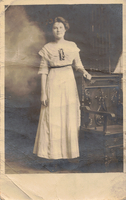
Postcard: Clara Stunick as Young Woman c. 1905–1910
As we trace the evolution of feminine elegance through the decades, we encounter a moment of quiet poise in the early 1910s with Clarice Auguste Zdunek (1894 – 1968). Captured in a studio portrait that would serve as a postcard, Clara embodies the shifting silhouettes of a changing era. Her dress, with its soft, gathered bodice and light, airy fabric, signals the departure from the rigid, heavy structures of the previous century toward the more fluid and graceful lines of the coming decade. Standing beside an ornate studio chair, she represents a generation of young women in Erie County poised on the threshold of modernity. This image is more than a mere record of fashion; it is a snapshot of youthful dignity, preserved in the delicate textures of lace and light. -

Seeing the Sights at Le Bourget
The 1971 Paris Air Show, which took place on May 5, was a busy, brightly colored affair, marked by the massive silhouettes of jet aircraft and the stylized uniforms of the era's flight crews. Carl Henry Haushalter (1925–2012), representing McDonnell Douglas, is captured amidst this professional bustle. There is a distinct sense of the era's aesthetic in the orange and navy uniforms of the hostesses, which contrast with the industrial scale of the aircraft in the background—aircraft Carl was instrumental in designing. -
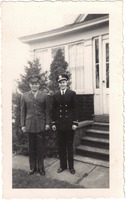
Service Dress at the Farmhouse Porch 1943
Standing before the white-trimmed porch of the Haushalter farmhouse, Carl Haushalter (1925–2012) and Mack Robinson present a more formal side of their service. In this view, the heavy winter coats are replaced by service dress uniforms, capturing a moment of polished pride. The scalloped edges of the print add a touch of mid-century domesticity to a scene defined by duty. It is a quiet, dignified portrait of two young men caught between the stability of home and the uncertainty of a world at war. -
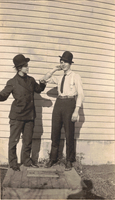
Sibling Playfulness at the Turn of the Century c. 1910
A playful moment between Anna Louise Zdunek (c. 1885–1959) and one of her brothers (likely Charlie, 1882–1910, or John, 1883–1961) offers a glimpse of youthful levity. Dressed in formal bowler hats and suits, the pair poses against the clapboard siding of a building, standing atop what appears to be a wooden well cover. Their spirited stance and slight smiles suggest a staged, lighthearted break from the daily rhythms of early 1900s life. This snapshot captures the Zdunek siblings in a moment of shared camaraderie, preserving a sense of personality and connection amidst the practicalities of their rural environment. -
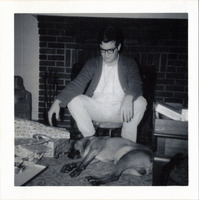
Snooper and his Man by Fireplace c. 1965
One of the Haushalter family sits on short stool in front of fireplace with Snooper lying contentedly at his feet by the fireplace at 6777 Gowanda State Road, c. 1965 -
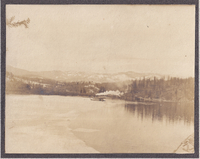
Steam and Timber at Mica Bay c. 1905
The rugged expanse of Mica Bay captures the industrial heart of the Idaho Panhandle during the early 1900s. In this view of Coeur d'Alene, the stillness of the water is broken by a plume of steam, signaling the relentless machinery of the logging industry. For Charlie Haushalter (1880–1963), these landscapes were not merely scenic vistas but demanding workplaces defined by timber, water, and heavy labor. This image serves as a window into a formative chapter of the Haushalter journey—a time spent amidst the log chutes and mountain camps of the West before the family's focus settled back onto the ancestral soil of New York. It captures a moment of transition, where the raw energy of the American frontier met the individual grit of a young man finding his way. -
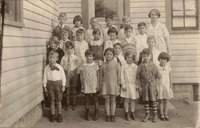
Students of the Water Valley Schoolhouse c. 1925
In the mid-1920s, the one-room Water Valley Schoolhouse stood as a cornerstone of local life. This portrait captures a group of young students, aged five or six, gathered on the steps for a class photo. Among them is Glenn William Haushalter (1919–1944). The children, in their sturdy knickerbockers and patterned dresses, embody the quiet, communal spirit of rural Hamburg. -
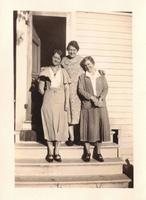
Stunick Sisters on Steps Niagara Falls Home c. 1930s
Three Stunick sisters stand on back steps of home at 204 77th St Niagara Falls, NY; from left to right, Minnie, Clara, Anna; summer or falls 1930s -
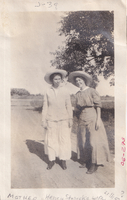
Summer Days at the Farmhouse c. 1915
Standing in the sun-drenched driveway of the Haushalter farmhouse, Edith Lillian Kerr (1889 – 1974) and Anna Zdunek (1885 – 1959) offer a charming glimpse into the practical elegance of the mid-1910s. This moment captures the intersection of seasonal necessity and period style; both women wear wide-brimmed sun hats to ward off the heat, yet their attire speaks to the nuanced layering required for life on a New York farm. Lillian, on the left, wears a heavier jacket or sweater over a lightweight cotton dress, a stylistic choice that highlights the growing importance of functional, adaptable clothing for women. Beside her, Anna embraces the lightness of the season in a patterned cotton dress. Together, they embody a generation of women moving away from the restrictive fashions of the past toward a more breathable, mobile, and modern way of being. -
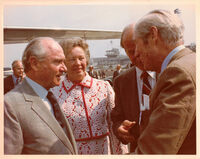
Tarmac Conversations: The Social Side of the 1971 Paris Air Show
Beyond the thunder of jet engines and the spectacle of flight, the Paris Air Show of 1971 was a theater of high-stakes networking. This candid moment captures the human side of the aerospace industry—the quiet, essential conversations that occurred on the tarmac. A woman in a striking red and white patterned blouse anchors a group of men in professional attire, their faces lit by the casual warmth of a shared discussion. Though the identities of these individuals remain a mystery, the scene perfectly encapsulates the social rhythm of the era. It is a glimpse into the world of industry representatives and their colleagues, where the future of global travel was negotiated not just through engineering, but through the human connection of a conversation amidst the sprawling airfield of Le Bourget. -
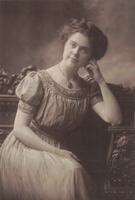
The Artifice of Elegance c. 1910
This likely platinum print of Anna Zdunek (1885–1959) presents a compelling contradiction between image and reality. While the portrait exudes an air of refined grace, the high-art medium and elegant empire-waist gown stand in stark contrast to the subject's actual economic circumstances. It is likely that this image was a carefully constructed studio performance, utilizing borrowed finery and the sophisticated, matte textures of the platinum process to create a vision of idealized femininity. Rather than a literal record of Anna's life in Buffalo, the photograph serves as a window into the commercial world of early 20th-century Pictorialism, where studios used professional models and borrowed elegance to transform the everyday into the extraordinary. In this light, the portrait becomes a fascinating study of how photography can craft a persona that transcends the lived experience. -
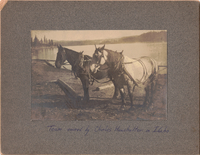
The Engines of the Timberlands c. 1905
In the rugged landscape of Coeur d’Alene, Idaho, between 1901 and 1907, the rhythm of life was dictated by the strength of muscle and the pull of timber. This photograph captures a working team owned by Charles Heinrich Haushalter (1880–1963) during his years in the logging camps. These draft horses were more than just animals; they were the essential engines of the Pacific Northwest timber industry, navigating the shoreline and heavy logs that defined the era's frontier economy. The image serves as a quiet testament to the grit required of a young man far from the settled fields of New York, finding his footing in the demanding, sawdust-scented world of Idaho logging. -
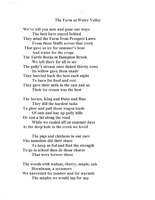
The Farm at Water Valley
Carl Haushalter's poem written as a remembrance of the Haushalter farm. -
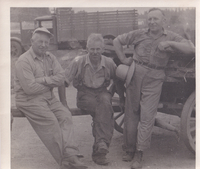
The Haushalter Brothers on Threshing Day c. 1940s or 1950s
The air of a threshing day is thick with the scent of dry chaff and the heavy, rhythmic pulse of machinery—a sensory marker of the seasonal cycle that defined the Haushalter existence. In this moment, captured amidst the iron and grit of the harvest, three brothers—Fred, George, and Walter—stand as a testament to the shared labor required to maintain their family’s stewardship of the Water Valley land. There is a quiet, weathered dignity in their poses; they are not merely subjects of a photograph, but the literal engines of the farm. As they pause against the backdrop of a heavy truck and the machinery of the harvest, we see the intersection of kinship and toil. This image preserves a fleeting instance of brotherhood, anchored to the fifty acres that remained in their hands for generations, capturing the grit, the exhaustion, and the profound pride of a life lived in rhythm with the soil. -

The Haushalter Farm
An account of a summer spent as hired labor on the Haushalter Farm, written by a friend of Carl Haushalter and fellow World War II soldier, Mack Robinson. The scan is currently missing pages which will be rescanned. -
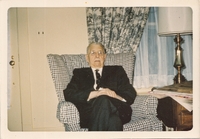
The Lord Mayor of Eden, Christmas 1969
Dave Thomas sits back in armchair in living room (6777?), Christmas 1969 -
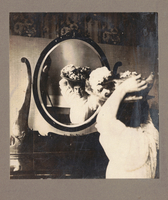
The Milliner’s Reflection c. 1910
In this evocative portrait, we catch a glimpse of Anna Zdunek Haushalter (1885 – 1959) not merely as a subject, but as an artist. Captured around 1910, the image uses the soft, reflective surface of an oval mirror to frame a moment of sartorial pride. Anna was at this time a professional dressmaker and milliner in the bustling city of Buffalo. The centerpiece of the image is the magnificent, flower-laden hat she holds—a sculptural feat of fabric and form that epitomizes the grand, romantic millinery of the Edwardian era. There is a profound sense of lived experience in this reflection; it captures the intersection of a woman’s professional identity and her personal grace. Through this lens, we see the transition of a young woman navigating the sophisticated fashion landscapes of urban New York, a skill and a sense of style that she would carry with her long after she moved from the city streets to the quiet rhythms of the Hamburg countryside. -
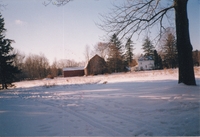
The Old Farmhouse in Winter c. 1980–1995
Looking across the snowy expanse of the fifty-acre property, the history of the Haushalter farm unfolds in a single vista. From the backyard of June Haushalter Casler (1920–2025) and Edwin Casler's (1918–2007) home, the original farmhouse stands as a silent sentinel of the past. Built by Charles Haushalter for his bride, Anna, in 1912, the white house and its accompanying barns—one a striking red, the other a weathered dark wood—represent the agricultural foundation of the family legacy. Though the land had been partitioned for different family dwellings, this view captures the enduring continuity of the Water Valley acreage. -
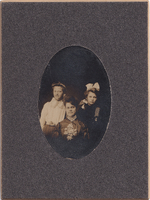
The Stunick Sisters, c. 1903
This evocative oval vignette portrait captures three sisters—Anna, Minnie, and Clara Stunick. Taken around 1903, the portrait beautifully illustrates the different stages of girlhood and womanhood at the turn of the century: Anna (Foreground): As the eldest, she is dressed more formally in a dark, structured bodice featuring intricate lace or embroidery at the neckline, signaling her transition into young adulthood. Minnie (Left): Wears a high-collared white blouse, a quintessential look for a teenage girl of the Edwardian era. Clara (Right): The youngest, her hair is adorned with a large, prominent white bow, a very common accessory for young girls during this period to denote youth and innocence. The handwritten notes on the reverse, documenting their ages and birth years, provide a secondary layer of history, reflecting the family's efforts to preserve their lineage. -

The Two Sides of Clarice Zdunek c. 1913
In a single studio sitting around 1913, Clarice Auguste Zdunek (1894 – 1968) captured the duality of her youth. These two portraits, later salvaged from an album and joined together on a black paper backing, offer a rare, intimate look at a young woman navigating the transition into adulthood. On the left, we see the Clara the world expected: composed, dignified, and dressed in the structured finery of the era, complete with a delicate lace jabot and a wide-brimmed hat. On the right, the studio's formality gives way to pure, unadulterated joy. With her arms raised and a wide, candid smile, she breaks the stillness of the portrait, revealing a spiritedness that transcends the era's social constraints. -

The Water Valley Inn c. late 1970s
The Water Valley Inn, also known as "the Ditch" by the Haushalter and Casler families, has been a staple of Water Valley life since the 19th century. Conveniently situated right at the base of the hill atop which the Haushalter farm sat, it provided a welcome place to grab a cold drink and comforting bite after a long day of work for generations of farmers and farmhands. -
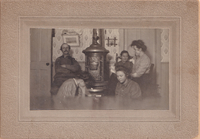
The Zdunek Family at Home c. 1907
The Zdunek family sits in their Angola home around their wood-burning stove circa 1907. In the rear, Michael Zdunek and Augusta his wife sit in chairs facing foward immediately next to the stove. Anna sits just in front of her mother, facing left across the field of the camera. Wilhelmina sits with her head bowed, facing somewhat back on the left in front of her father, perhaps reading a book. Clara sits front right, eyes lowered. The photo is mounted in a brown, textured, ornamental cardboard frame. "Michael Stunick, Minnie Stunick, Clara Stunick, Augusta Stunick, Anna Stunick at home Angola, NY c. 1907" written on back