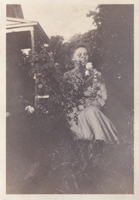
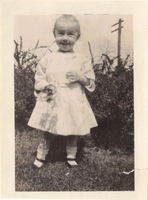
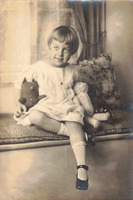
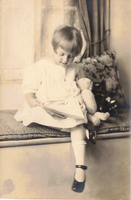
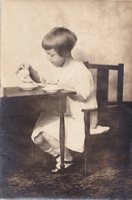
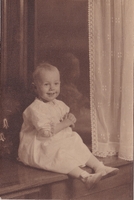
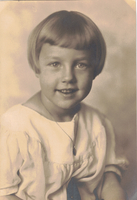
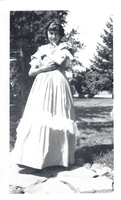
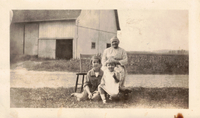
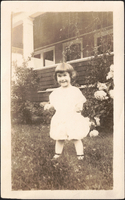
June stands as if dressed for costume event of some sort in wide-skirted dress with ruffle at middle; she has bow in hair and a cat in her arms in the yard of the Haushalter farmhouse c. 1934
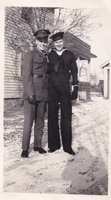
This picture captures Mack Robinson and Carl Haushalter on leave in 1943. Having previously worked together performing the intensive manual labor required by the Haushalter truck farm in Water Valley, New York, the two are pictured here in their respective military uniforms. Robinson stands on the left in a United States Army Service Uniform, while Haushalter, on the right, wears the United States Navy service dress. The photograph, taken outdoors against the siding of the Haushalter farmhouse, likely during the winter or early spring, serves as a visual record of the shift from rural agricultural life to the global mobilization of World War II. It documents the shared history of two friends whose lives were redirected from the agricultural fields of Erie County to the service of their country.
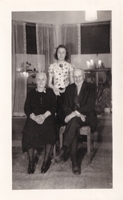
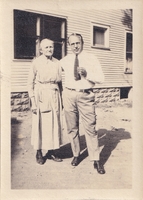
Mary Heinrich Haushalter, with eyes mostly shut as if she may by now be blind, standing with son Fred Haushalter outside unknown house c. 1920; Mary in loose dress with collar, Fred in suit and tie with cigar in one hand and other arm around his mother
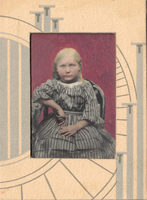
This hand-tinted version of Mary Heinrich’s portrait reveals the artistry of the 19th-century photographic studio. By applying delicate washes of color to the skin tones and a rich, textured pigment to the background, the photographer has transformed a standard carte de visite into a unique work of art. The deep, dramatic hues of the background create a striking contrast, drawing the viewer's eye directly to Mary's youthful expression. This colorization represents a moment in history when photography was transitioning from a purely scientific process into an expressive art form, used by families to create lifelike, cherished keepsakes that felt more 'real' than the silver-toned prints of the time.
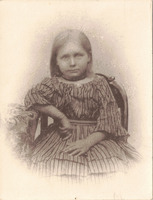
This carte de visite captures a young Mary Heinrich (1853–1926) during her childhood, likely in the mid-1860s. Born in Eden, New York, to Jean-George Heinrich and Salome Wohlhuter, Mary was a member of the prominent Heinrich family, another foundational lineage of the Water Valley area. This portrait captures her in the striped dress and simple hairstyle typical of the mid-Victorian era, years before she would marry George 'Henry' Haushalter in 1877. This image serves as a poignant visual record of the era when these families were establishing the social and agricultural fabric of Erie County, documenting a life that began in Eden and eventually helped shape the legacy of the Haushalter farm for generations to come.
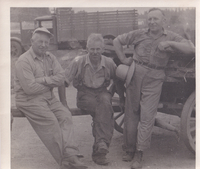
The air of a threshing day is thick with the scent of dry chaff and the heavy, rhythmic pulse of machinery—a sensory marker of the seasonal cycle that defined the Haushalter existence. In this moment, captured amidst the iron and grit of the harvest, three brothers—Fred, George, and Walter—stand as a testament to the shared labor required to maintain their family’s stewardship of the Water Valley land. There is a quiet, weathered dignity in their poses; they are not merely subjects of a photograph, but the literal engines of the farm. As they pause against the backdrop of a heavy truck and the machinery of the harvest, we see the intersection of kinship and toil. This image preserves a fleeting instance of brotherhood, anchored to the fifty acres that remained in their hands for generations, capturing the grit, the exhaustion, and the profound pride of a life lived in rhythm with the soil.
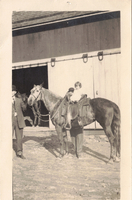
Doris Haushalter as a toddler on a brown horse in front of the open doors of the horse barn on the Haushalter farm, two men standing by and another horse behind in the barn door, c. 1916
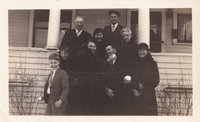
In the biting chill of a LaSalle winter, 1937, the gravity of family loss is momentarily eclipsed by the simple joy of a snowball fight. Gathered on a porch, several generations of the Zdunek and Stunick kin find a moment of levity. From the elder Augustus Carl Ludwig (1867–1938) to the youthful Carl Haushalter (1925–2012), the image captures a rare, unposed spontaneity. Anna Louise Haushalter (1885–1959), Michael Stunick (1889–1961), and Clarice Liddle (1894–1968) stand amidst the laughter, alongside Frances Warder Swain (c. 1870–post 1930), a testament to the enduring bonds that anchored the family. It is a snapshot of resilience, where even in the depths of winter and mourning, the warmth of kinship prevails.