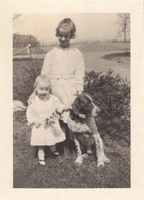
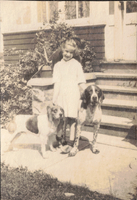
Doris stands with her arm on June's shoulder, June with spring of flowers in hand and other hand on Rex's back near the drive on the Haushalter farm, c. 1921
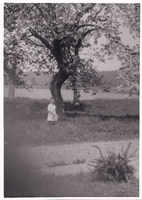
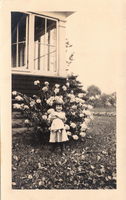
Doris standsin distance by a very old apple tree on the Haushalter farm by the drive in a dress with bow in hair c. early 1920s; she's holding an unknown object
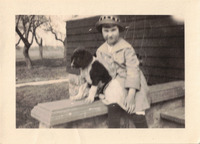
Doris in coat and hat with black and white dog on Haushalter farmhouse steps c. 1922; she wears a coat over a white dress with black stockings, a round hat with striped ribbon on her head
Doris Haushalter standing next to side of enclosed Haushalter farmhouse porch, summer c. 1918; she has a doll in her arms and is standing in front of a flowering shrub
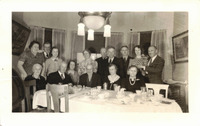
The whole family poses for a photo seated and standing behind the dining room table in the Haushalter farmhouse, c. 1940s
Standing (left to right): Clarice Zdunek Liddle, Milton Agle, June Haushalter, Anna Zdunek Haushalter, William D. Haushalter, George J. Haushalter, Dave Thomas, Doris Haushalter Agle, Alfred Liddle
Seated (left to right): Louisa Sigel Gallman, Charles Heinrich Haushalter, Wilhelmina Zdunek Thomas, George H. Haushalter, Lydia Pfitzinger Haushalter, Ada Gallman Haushalter
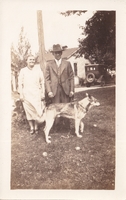
Ada and George Haushalter stand in front of what looks like a telephone pole in their own yard in Eden with their dog Rex c. 1927; there is a 1920s or 30s-era car and their creamery shed in the background
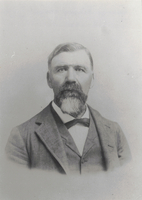
This formal portrait depicts George Edward Casler (1829–1920), a man whose life was defined by the industrious spirit of late 19th-century New York. A teamster and landowner in Sullivan, Madison County, George was deeply involved in the local economy, managing land and coal interests alongside his family. In this image, likely captured between 1885 and 1895, George is presented with the dignity afforded to a successful tradesman of the era. He wears a formal waistcoat and bow tie, and his well-maintained beard reflects the grooming standards of a mature Victorian gentleman. The photograph utilizes a "vignette" style—a popular studio technique that softly fades the edges of the portrait—focusing all attention on his steady gaze.
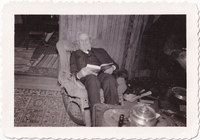
Grandpa George reclines in his favorite chair in his kitchen by his wood cookstove, humoring the photographer by looking up from his book; wearing suit c. 1940
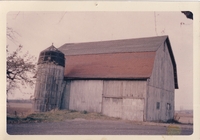
This image captures the architectural heart of a life spent in service to the land. Taken in the late summer of 1966, the photograph depicts the expansive barn and silo on George J. Haushalter’s farm in Eden, New York—a structure that stood as a silent witness to decades of agricultural labor. More than just a building, this barn was a complex ecosystem of farm life, sheltering the hay, livestock, and machinery that sustained the household. As the sun of a late summer afternoon rests on the weathered siding, the image captures a sense of profound stability and the quiet dignity of the American family farm. This photo, taken in the "late summer of 1966," represents one of the final visual records of George J. Haushalter’s stewardship of his Webster Road farm. George, who had married Ada Gallman in 1906 and spent the better part of sixty years cultivating this land, passed away in August of that same year.
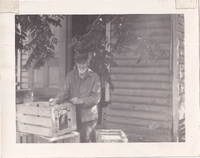
In the war years of the early 1940s, George Haushalter stands before the farm's ice house, mending the wooden crates that carried the season's lettuce to market. At nearly ninety, the patriarch remains a visible presence in the Water Valley landscape, captured here in a moment of quiet, manual maintenance. While the image shows George engaged in the essential labors of the farm, his role in the family's history was defined more by his scholarly and civic contributions—as a postmaster, a school clerk, and a community reader—than by the rigors of agricultural management. By this time, the farm had long since moved past its earlier periods of volatility; the stability and continuity of the Haushalter holdings were the result of the steady, decades-long stewardship of his son, Charles, who had been at the helm since he came back from Idaho about 1907.
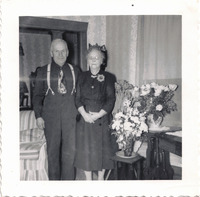
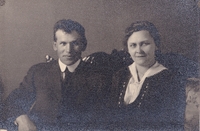
In this intimate portrait, likely captured around 1913, Ada Gallman's (1881–1969) attire reflects a sophisticated balance of domestic grace and emerging modernity. Her dark bodice is framed by a striking, high-contrast white collar, featuring delicate scalloped edges and fine embroidery that speaks to the meticulous textile standards of the period. This style of ornamentation was essential for brightening the face in studio photography, marking a moment when women's fashion moved toward the cleaner, more functional lines that would soon define the decade. Beside Ada, George Jacob Haushalter (1882–1966) provides a warm, spirited counterpoint; the "gleam in his eye" noted by a family member in the marginalia suggests a playful character that softens the formality of his high-collared suit, immortalizing a moment of shared connection in the lives of a couple who would go on to build a sixty-year legacy in Eden.
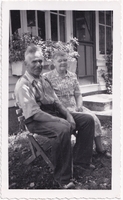
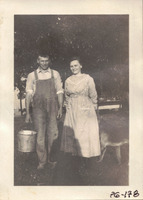
This snapshot provides a candid glimpse into the early married life of George Jacob Haushalter and Ada L. Gallman on their farm along Webster Road in Eden, New York, likely captured between 1910 and 1920. Moving away from the formal, stiff portraiture of the previous century, this image captures a moment of domestic reality: George stands in utilitarian work overalls holding a metal bucket, while Ada wears a practical, patterned day dress. The presence of a dog in the foreground and a simple outdoor table in the background underscores the lived-in, working nature of their homestead.
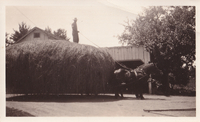
Perched atop a mountain of summer’s labor, George Jacob Haushalter stands as a testament to the grit and seasonal rhythms of the Eden, New York farmstead. This image, captured during the transformative decades of the 1930s or 40s, depicts more than just a successful harvest; it captures a moment of quiet mastery over the land. As George looks out from his hay-laden pedestal on Webster Road, the sheer scale of the load underscores the physical demands of mid-century farming, where the strength of the horse and the endurance of the man were the primary engines of survival. While the era was on the cusp of a technological revolution brought by rural electrification, this scene remains anchored in the traditional stewardship that defined the Haushalter lineage. It is a portrait of a man deeply integrated into his environment, standing amidst the literal fruits of his toil, embodying the pride and the heavy lifting required to maintain a family legacy in the fertile soil of Erie County.
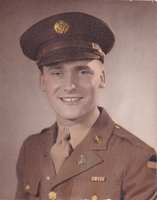
This portrait captures Glenn William Haushalter (1919–1944), a young man whose life would end tragically in the countryside of Brittany during the Second World War. A native of Water Valley, New York, and a trained educator, Glenn had begun a promising career as a school principal in Mahwah, New Jersey, before his life shifted from the classroom to the battlefield. Pictured here in his United States Army service uniform, Glenn’s bright expression belies the heavy responsibilities he would soon shoulder as a Staff Sergeant in the 23rd Infantry, 2nd Division. This image serves as a poignant testament to a generation of young Americans who transitioned from civilian professional life to the front lines of Normandy and Brittany.
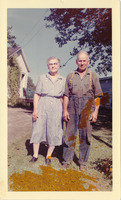
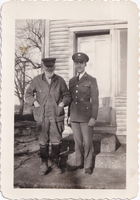
This photo, documented by contemporary correspondence to have been taken December 7, 1941—the day the United States was thrust into World War II—captures a moment of staggering historical and personal synchronicity. Set against the backdrop of the Haushalter farm, it presents a quiet, domestic tableau at the instant the era of American isolationism ended. On the left, the family patriarch, George Haushalter (1852–1944), in the rugged workwear of a lifelong farmer; beside him, his grandson, Glenn William Haushalter (1919–1944), on furlough in his U.S. Army Corporal's uniform. The profound tragedy of the image lies in its timing: captured the day the world changed, both men would be gone within three years—George passing quietly at home on the farm in early 1944, and Glenn falling in combat in France later that same year.
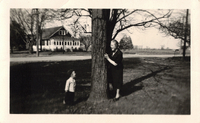
Anna stands half-hidden behind a tree peeking out at her grandson, who grins up at her, Gowanda State Rd in background from Haushalter farmhouse yard, 1 Sep 1946
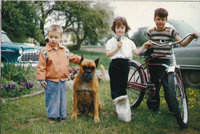
One of the Haushalter children stands with hand on Snooper, another eating an ice cream and a third with his bike in the farmhouse yard with 50s cars behind c. 1959
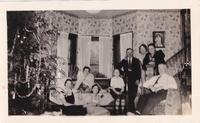
Doris, Anna, June, Carl, George and Ada Haushalter joined by Minnie Stunick Thomas in Haushalter farmhouse living room for Christmas c. 1933; decorated tree on left