

Items
-
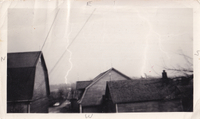
Lightning Strike at Haushalter Farm c. 1937
A sudden fracture in the sky, captured in a flash of silver and shadow, this image preserves a moment of raw atmospheric power over the Haushalter farm circa 1937. While the lightning bolts strike with violent brilliance, the farm buildings stand as dark, resolute silhouettes against the electrical upheaval, embodying the stoic presence of the homestead during the late Depression era. The inclusion of cardinal directions etched onto the print edges reveals a desire to map and master the landscape, treating the farm not just as a home, but as a specific, documented territory. Yet, there is a haunting quality to the image when viewed through the lens of the family’s later notes; the very structures that once weathered these storms would eventually succumb to the weight of snow and the slow march of time. This photograph serves as a temporal bridge, linking the vibrant, elemental energy of the 1930s to the quiet, inevitable shifts in the stewardship of these fifty acres. -
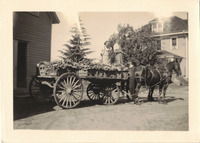
Michael Stunick and Robert Van Allen in Farm Wagon c. 1932
During summer in the 1930s, the Haushalter farm was a landscape of rhythmic, heavy labor, a reality captured here in a moment of shared productivity. Michael Stunick—brother to Anna Zdunek Haushalter—and Robert "Bob" Van Allen, a friend and neighbor, stand together in the bed of a heavily laden wagon, surrounded by the leafy bounty of the season. This image, preserved through the keen, observant notes of Carl Haushalter, records more than just a harvest; it captures the very bones of the farmstead, from the original wooden steps of the farmhouse to the sheltering tree by the cellar entrance. -
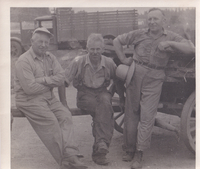
The Haushalter Brothers on Threshing Day c. 1940s or 1950s
The air of a threshing day is thick with the scent of dry chaff and the heavy, rhythmic pulse of machinery—a sensory marker of the seasonal cycle that defined the Haushalter existence. In this moment, captured amidst the iron and grit of the harvest, three brothers—Fred, George, and Walter—stand as a testament to the shared labor required to maintain their family’s stewardship of the Water Valley land. There is a quiet, weathered dignity in their poses; they are not merely subjects of a photograph, but the literal engines of the farm. As they pause against the backdrop of a heavy truck and the machinery of the harvest, we see the intersection of kinship and toil. This image preserves a fleeting instance of brotherhood, anchored to the fifty acres that remained in their hands for generations, capturing the grit, the exhaustion, and the profound pride of a life lived in rhythm with the soil. -
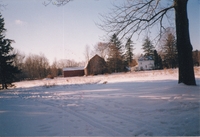
The Old Farmhouse in Winter c. 1980–1995
Looking across the snowy expanse of the fifty-acre property, the history of the Haushalter farm unfolds in a single vista. From the backyard of June Haushalter Casler (1920–2025) and Edwin Casler's (1918–2007) home, the original farmhouse stands as a silent sentinel of the past. Built by Charles Haushalter for his bride, Anna, in 1912, the white house and its accompanying barns—one a striking red, the other a weathered dark wood—represent the agricultural foundation of the family legacy. Though the land had been partitioned for different family dwellings, this view captures the enduring continuity of the Water Valley acreage. -
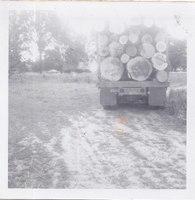
Truck with Logs on Haushalter Farm c. 1950s
In the 1950s, the harvest of a 54-inch diameter Black Walnut served as a practical application of the forest management practices maintained on the Haushalter farm. This was not a random clearing of land, but a calculated part of the property's stewardship, informed by Charlie Haushalter’s formative years working in the logging camps of Idaho. By monitoring the wooded sections of the 50-acre acreage and harvesting timber according to established best practices, the family integrated forestry into their broader agricultural management. This image captures the result of that informed approach: the systematic management of a long-standing natural resource.