

Items
-
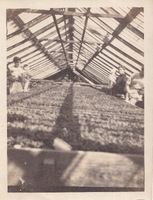
"The Old Greenhouse" c. 1914
This soft-focused snapshot provides an intimate, interior view of the greenhouse on the Haushalter farm in Water Valley, New York. Identified by family records as featuring Anna Louise Haushalter with her infant daughter, Doris (born 1914), the image captures a quiet moment beneath the slatted roof of a structure that was central to the farm's agricultural operations. This specific greenhouse was a long-standing fixture of the 50-acre property, serving the family until it was replaced in the early 1930s. -
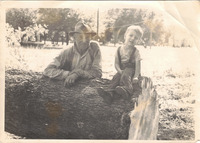
A Moment's Rest c. 1949
Here, Charles Haushalter (1880–1963) takes a brief respite from the heavy labor of the farm, perched upon a massive, freshly felled log. Beside him sits his grandson, looking up with the bright curiosity of early childhood. The rough bark of the timber and the sturdy suspenders worn by both generations speak to a life lived close to the earth. It is a quiet, unposed snapshot of continuity—a passing of time captured amidst the trees of Water Valley. -
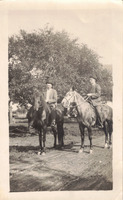
A Pause on the Water Valley Road c. 1920
Along the unpaved main road in Water Valley, Charles Haushalter (1880–1963) and an unidentified companion pause on horseback. The setting is familiar and domestic, with a few apple trees near the farmhouse providing a leafy backdrop. Dressed in the sturdy jackets and hats of the early 20th century, the men sit with a composed presence. The dirt road beneath them marks the landscape of a different era, a time when the farm’s connection to the community was defined by these unpaved thoroughfares and the steady rhythm of the horse. -
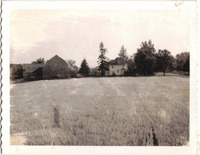
A View of the Haushalter Farmstead c. 1940s or 1950s
From the vantage point of the Casler residence, the landscape unfolds with the sturdy farmhouse nestled among mature trees and the massive barn standing sentinel to the left. The wide field in the foreground, likely a seasonal crop, stretches toward the buildings that anchored the family for generations. With Gowanda State Road just on the edge of the frame to the right, the scene reflects the intersection of domestic peace and the working agricultural life that defined this fifty-acre property. -
Autumn in the Woods
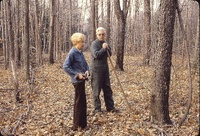
In the waning light of the late 1970s, June Haushalter Casler (1920–2025) and Edwin Casler (1918–2007) stand amidst the quiet woods of the family farm in Water Valley. The ground is thick with the copper-colored leaves of autumn. Ed, leaning on a thick walking stick, and June, in a sturdy denim jacket, share a moment of quiet companionship. This image captures a period long before the eventual subdivision of the land in the early 2000s. -
Barred Chicken in Winter c. 1922
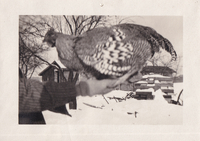
The archive preserves a vivid snapshot of the agricultural pride that defined Hampton Brook Farm in the 1920s. Through the striking, patterned plumage of a Barred Rock rooster and the elegant purple satin of a "Champion Male" ribbon, we see the dual nature of the Haushalter family's success: the tangible quality of their livestock and the formal recognition they earned within the regional poultry community. Whether this specific bird was the one that carried the Flower City Poultry & Pigeon Association award or simply a representative of the high standard maintained on the farm, the items together tell a story of excellence. They capture a moment when the rhythms of the 50-acre farm were measured not just by seasonal harvests, but by the prestige of the prize ribbon and the meticulous stewardship of the land and its creatures. -
Borchert Combine on Front Acreage c. 1950s
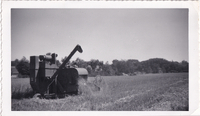
In the mid-1950s, the rhythmic discharge of grain from a Borchert combine marked the height of the harvest season on the Haushalter farm. Positioned on the front acreage, the machine faces the wooded descent of "The Gully"—the natural, deep dip in the landscape that served as the farm's topographical spine, dividing the front acreage from the eastern back acreage. This view captures a moment of mechanical progress set against a landscape defined by its ancient, rugged contours: the wooded hollow where a dirt road once dipped down to cross a modest bridge over a seasonal trickle of water. -
Carl Stunick Drives Hay Rake behind Dan, July 1921
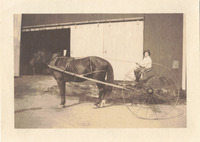
In the heavy heat of July 1921, a young Carl Stunick sits perched atop a horse-drawn hay rake, a small figure amidst the formidable machinery of the Water Valley harvest. This image captures more than just a child at play; it documents a moment of connection between the extended Zdunek family and the fifty acres of land they helped sustain. As the nephew of Anna Zdunek Haushalter, Carl’s presence here underscores the deep, interlocking kinship ties that defined the Haushalter farm's social landscape. Beside him, the horse Dan stands in quiet patience, a silent partner in the seasonal rhythms of labor and life. -
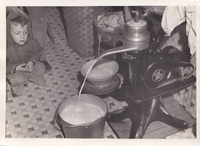
Casler Boy Contemplates Milk Separator c. 1951
Here, a young Casler crouches on the checkered linoleum of the laundry room, his gaze fixed on the mechanical marvel of the De Laval cream separator. The handwritten note describing his "contemplation of the mysteries" perfectly captures the intersection of childhood wonder and the heavy, cast-iron reality of dairy farming. This is not merely a domestic snapshot, but a portrait of a child being raised amidst the tools of stewardship. As the separator worked to process the farm's output, it provided the backdrop for a generation of the Haushalter-Casler lineage to grow up intimately acquainted with the labor and the machinery that sustained their family's fifty-acre legacy. -
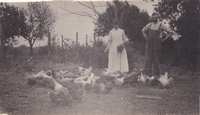
Charles and Anna Haushalter and the Plymouth Rocks c. 1915
This candid snapshot, captured circa 1915, offers an intimate glimpse into the daily life and agricultural pride of Charles Heinrich Haushalter and Anna Louise Zdunek on their 50-acre farm in Water Valley. This image depicts the couple in their element: the chicken yard. The presence of the Plymouth and Barred Rock chickens is particularly significant; these breeds were not merely livestock but a point of professional distinction for Charles, who would go on to earn various county and state fair awards for them in the years following this photograph. The image captures a moment of domestic industry, illustrating the close relationship between the Haushalter family and the land they would steward for generations. -
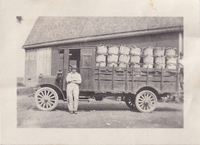
Charles Haushalter and the Dawn of Motorized Farming
Captured circa 1920, this image depicts Charles Heinrich Haushalter standing beside his 1920 Service Motor truck, loaded with crates of produce ready for a 2:00 AM trip to market. This photograph captures a pivotal moment in American agricultural history: the transition from horse-drawn wagons to the reliability of motorized transport. The heavy load and the ruggedness of the Federal truck underscore the grueling, early-morning labor required to maintain the Haushalter farm in Water Valley, New York. Charles, dressed in practical work overalls, represents the hardworking backbone of the Hamburg community—a man who was not only a farmer but a founding member of the local Rod and Gun Club and an active participant in the Erie County Growers and Shippers' Association. -
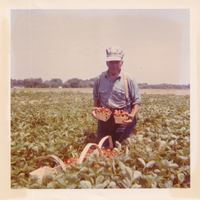
Charles Haushalter Harvests Strawberries in the 1960s
In the sun-drenched rows of the Water Valley farm, Charles Haushalter stands as a bridge between the grit of agrarian labor and the promise of the next generation. Captured around 1960, this moment shows Charles amidst a bountiful strawberry harvest, holding the very fruit that would help fund his grandson John’s journey to Harvard. The image captures the dual nature of the Haushalter legacy: it is simultaneously a record of disciplined stewardship and a backdrop for the spirited chaos of family life. While the strawberries represented a serious investment in academic opportunity, family recollections also recall the lighter side of the harvest, with the berries occasionally being used as ammunition by the grandchildren in playful skirmishes against passing cars, as recorded in Carl Haushalter's 2004 catalog note: "Dad with strawberrys [sic] ready for Jim and Kurt to throw at passing non-buyers' cars." -
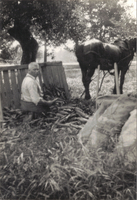
Charles Haushalter Stores Corn
This candid snapshot captures Charles Heinrich Haushalter engaged in the seasonal labor of sorting corn on the family farm. Taken under the shade of the farm's "old apple trees," the image provides a glimpse into the manual rhythms of mid-20th-century agriculture. Charles, a tireless worker, is seen here in his natural element, performing the essential tasks that sustained the Haushalter legacy for generations. The presence of his horse, Dan, in the background serves as a visual reminder of the close partnership between farmer and animal that was central to the era's agricultural life. -
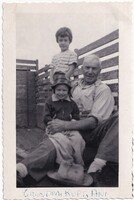
Charles Haushalter with Grandchildren c. 1956
Captured in the utilitarian bed of a Stewart farm truck, this 1956 snapshot offers a tender glimpse into the generational continuity of the Haushalter farm. The image moves beyond a simple family portrait, placing the subjects directly within the tools of their livelihood. As Charlie Haushalter holds young grandson, his granddaughter standing watch behind them, the photograph captures a quiet intersection of domestic affection and the rugged reality of rural life in Water Valley. It is a moment of stillness amidst the seasonal rhythms of the fifty-acre property, documenting a period when the family’s presence was deeply woven into the landscape and the machinery that sustained it. -
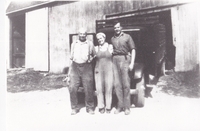
Charles, Anna and Carl Haushalter by Horse Barn, Summer 1946
In the summer of 1946, as the shadows of the Second World War began to recede, the Haushalter family stood together before the Stewart Truck and Horse Barn, a testament to the enduring continuity of their fifty-acre farm in Water Valley. Dressed in the heavy denim and functional workwear of the farm—Anna and Carl in sturdy overalls—the trio embodies the grit and resilience required to maintain the land. The image captures a pivotal moment of transition: the intersection of traditional animal husbandry and the burgeoning mechanization of the mid-century American landscape. For the Haushalters, this moment was more than a simple family snapshot; it was a quiet reclamation of normalcy and a reaffirmation of their multi-generational commitment to the soil of Hamburg, New York. -
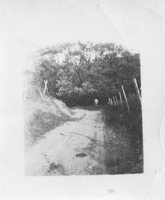
Cow in Haushalter Farm Lane
This diminutive snapshot, measuring only 2.5 inches on its longest edge, offers a unique and playful window into the early years of the Haushalter farm in Water Valley. Likely captured in the late 1920s or early 1930s, the image possesses a characteristic "haze" and soft focus, typical of the consumer box cameras used by families during this era. While the photograph itself is an ambiguous view of a farm lane, the inscription on the reverse—"Our Lane -- That white object is a cow -- not me!"—provides a vital temporal and spatial anchor. The note, believed to be a reaction by a young June Haushalter, suggests she was present on the farm during this period, using the photographic ambiguity of the scene to share a moment of humor. -
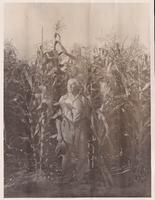
Dwarfed by the Corn c. 1955
Standing amidst the towering stalks of a Water Valley cornfield, Charles Haushalter (1880–1963) in his seventies possesses a sturdy presence amidst the crop he has spent a season tending. The mature corn, heavy with tassels, marks the height of the growing season—a moment of seasonal culmination. -
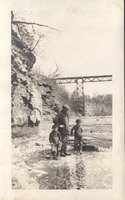
Fishing at the Edge of the World c. 1910–1925
Along the northeastern boundary of the Haushalter farm, the waters of the 18-Mile Creek served as both a natural border and a place of quiet instruction. In this candid moment from the early 20th century, an unidentified man and two young boys wade through the shallow cascades, their fishing rods poised against the rocky terrain. The scene captures the simple, rhythmic labor of rural childhood, yet it is framed by a looming symbol of progress: the massive steel railroad trestle cutting through the valley behind them. -
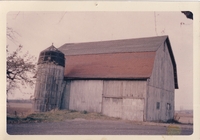
George Haushalter Barn 1966
This image captures the architectural heart of a life spent in service to the land. Taken in the late summer of 1966, the photograph depicts the expansive barn and silo on George J. Haushalter’s farm in Eden, New York—a structure that stood as a silent witness to decades of agricultural labor. More than just a building, this barn was a complex ecosystem of farm life, sheltering the hay, livestock, and machinery that sustained the household. As the sun of a late summer afternoon rests on the weathered siding, the image captures a sense of profound stability and the quiet dignity of the American family farm. This photo, taken in the "late summer of 1966," represents one of the final visual records of George J. Haushalter’s stewardship of his Webster Road farm. George, who had married Ada Gallman in 1906 and spent the better part of sixty years cultivating this land, passed away in August of that same year. -
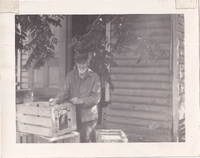
George Haushalter Repairs Lettuce Crate c. 1942
In the war years of the early 1940s, George Haushalter stands before the farm's ice house, mending the wooden crates that carried the season's lettuce to market. At nearly ninety, the patriarch remains a visible presence in the Water Valley landscape, captured here in a moment of quiet, manual maintenance. While the image shows George engaged in the essential labors of the farm, his role in the family's history was defined more by his scholarly and civic contributions—as a postmaster, a school clerk, and a community reader—than by the rigors of agricultural management. By this time, the farm had long since moved past its earlier periods of volatility; the stability and continuity of the Haushalter holdings were the result of the steady, decades-long stewardship of his son, Charles, who had been at the helm since he came back from Idaho about 1907. -
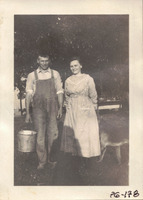
George J. and Ada Gallman Haushalter with Dog c. 1910-1920
This snapshot provides a candid glimpse into the early married life of George Jacob Haushalter and Ada L. Gallman on their farm along Webster Road in Eden, New York, likely captured between 1910 and 1920. Moving away from the formal, stiff portraiture of the previous century, this image captures a moment of domestic reality: George stands in utilitarian work overalls holding a metal bucket, while Ada wears a practical, patterned day dress. The presence of a dog in the foreground and a simple outdoor table in the background underscores the lived-in, working nature of their homestead. -
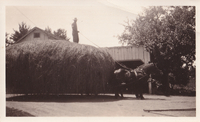
George J. Haushalter atop Haywagon c. 1930s
Perched atop a mountain of summer’s labor, George Jacob Haushalter stands as a testament to the grit and seasonal rhythms of the Eden, New York farmstead. This image, captured during the transformative decades of the 1930s or 40s, depicts more than just a successful harvest; it captures a moment of quiet mastery over the land. As George looks out from his hay-laden pedestal on Webster Road, the sheer scale of the load underscores the physical demands of mid-century farming, where the strength of the horse and the endurance of the man were the primary engines of survival. While the era was on the cusp of a technological revolution brought by rural electrification, this scene remains anchored in the traditional stewardship that defined the Haushalter lineage. It is a portrait of a man deeply integrated into his environment, standing amidst the literal fruits of his toil, embodying the pride and the heavy lifting required to maintain a family legacy in the fertile soil of Erie County. -
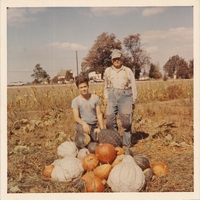
Grandson and Charlie with Squash for Erie County Fair c. 1960
Posed amidst the sprawling vines of the family fields, Charles Haushalter and his grandson present a formidable collection of squash destined for the Erie County Fair. The variety of the gourds—from heavy, pale-ribbed specimens to bright, sun-ripened golden delicious squash—speaks to a season of careful cultivation and the competitive spirit inherent in Erie County’s farming traditions. This moment highlights the pride the Haushalters took in the fruits of their labor. -
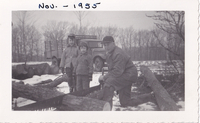
Haushalter Grandchildren Logging with Grandpa, Nov 1955
As Charlie Haushalter leans over the timber in the Water Valley woodlot, he is wielding more than just a tool; he is wielding a piece of his own history. The two-man logging saw he uses is the very same one that carried him through the rugged logging camps of Idaho at the turn of the century. Having returned to the family farm in 1907 to rescue the farm from the brink of ruin, Charlie brought the hard-won skills of the West back to the soil of New York, carrying with him the quiet regret of the life he had left behind in the Idaho woods. For his grandchildren, this moment of "observing" might serve as a silent lesson in resilience. Through the rhythmic, heavy pull of that old saw, the family's past sacrifices and their enduring commitment to the fifty-acre farm are made tangible, bridging a lifetime of labor and a landscape of shifting identities. -
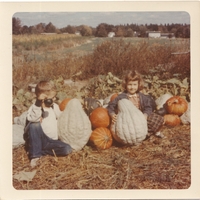
Haushalter Grandchildren with Grandpa Charlie's Prize Squash c. 1960
While the adults of the Haushalter adults approached the harvest with the focused intent of competitors, the children experienced it as a landscape of play and wonder. In this candid moment from circa 1960, twof of Charles Haushalter's grandchildren are nestled among the very same prize-winning squash destined for the Erie County Fair. The massive, pale gourds and sun-colored golden delicious squash seem almost larger than the children themselves, creating a scene where the bounty of the land serves as both a playground and a backdrop for a rising generation.