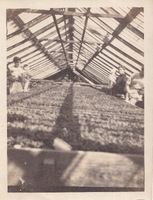
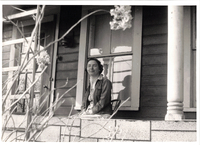
This soft-focused snapshot provides an intimate, interior view of the greenhouse on the Haushalter farm in Water Valley, New York. Identified by family records as featuring Anna Louise Haushalter with her infant daughter, Doris (born 1914), the image captures a quiet moment beneath the slatted roof of a structure that was central to the farm's agricultural operations. This specific greenhouse was a long-standing fixture of the 50-acre property, serving the family until it was replaced in the early 1930s.
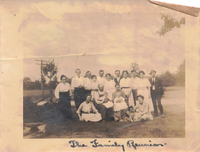
Group photo of Stunick and Lodwig families including Julius, John, Irene, Charles Haushalter, Anna, Michael Jr, Olive, Henry, Alfred Liddle, Wilhelmina, Michael Sr, Doris Haushalter, Augusta, Carl and Clara, plus one unknown figure; photo can be dated by Doris' early 1914 birthday
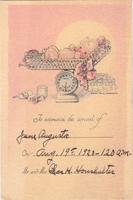
Printed in pink and black on yellowing paper, the card records June's basic vital information:
"To announce the arrival of
June Augusta
on Aug. 19th 1920—1.20 a.m.
Mr. and Mrs. Chas H. Houshalter
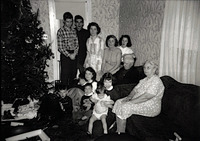
The Casler family is gathered in a living room beside a decorated Christmas tree, opened presents strewn on the floor.
"1952" written on back
From left to right—
Back: Edwin Casler, Ronald Joseph Thomas, Alice Casler, Norma Casler, June Haushalter Casler
Front: Gary Pickard, ..., Pat Pickard, ..., ..., Barbara Hughes, Joseph Andrew Casler, Johanna Conners Casler
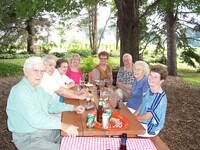
In 2004, a group of Haushalters and Caslers gathers for refreshment in the cool shade thrown by the firs planted by Charles Haushalter c. 1907. In the top left corner, backlit behind the trees, you can catch a glimpse of the new homes that had just been constructed on the old farmland after it was sold in 2003. In 2004, June and Ed's house sat on the only piece of the original fifty acres that still remained in Haushalter hands. From left to right: Edwin Casler, Ronald Thomas, Shirley (Martin) Thomas, Patricia (Thomas) Wickens, friend of Carl's, Carl Haushalter, June (Haushalter) Casler, a Casler child-in-law.
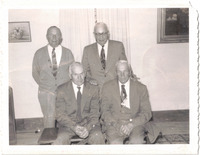
This formal portrait captures a rare convergence of the Haushalter brothers, likely during a period of family transition around 1961. The presence of Frederick Martin Haushalter (1886-1966), who lived far from the farm, suggests a reunion perhaps prompted by the passing of the eldest brother, William Daniel (1878-1961). Seated in the foreground are George Jacob Haushalter (1882-1966) and Charles Henry Haushalter (1880-1963), with Walter Edward 'Dick' Haushalter (1889-1980) and Frederick standing behind. Dressed in formal attire, the men present a dignified, somber unity.
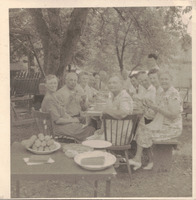
Under the dappled shade of a tree, a group of women gathers around a table for a seasonal meal. Anna Zdunek Haushalter (1885–1959) sits near the front on the right-hand bench, accompanied by Doris Haushalter. Irene Pallister Haushalter (1892–1976) is visible on the left-hand bench, second from the back. A platter of corn rests on the table, a direct link to the crops grown in the family's fields.
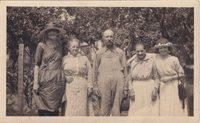
In the dappled light of a summer afternoon, the Zdunek family gathers for a portrait in Angola, New York. The group represents the strength of a family built on German immigrant roots. At the center stands patriarch Michael Zdunek (1854–1938), flanked by his wife, Augusta (Ludwig) Zdunek (1853–1927). The presence of Anna (Lodwig) Kalla (1858–1917), Augusta’s sister, places this scene just before her passing. Around them, the younger generation—Clarice Auguste Zdunek (1894–1968) and Irene (Teague) Zdunek (1895–1971)—stand with poised expectation, their fashions bridging the Edwardian era and the coming decade.
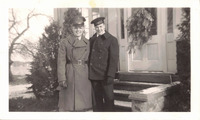
Carl Haushalter (1925–2012) and his friend Mack Robinson stand on the familiar back steps of the Haushalter farmhouse, a brief pause in the whirlwind of the Second World War. Clad in heavy Navy wool—a greatcoat and a pea coat—they offer bright, youthful smiles that defy the gravity of the era.
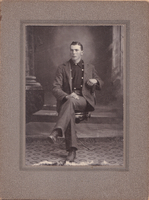
Charles Heinrich Haushalter (1880–1963) sits for a portrait that bridges two vastly different worlds. Dressed in a sturdy, patterned jacket and formal waistcoat, he presents a composed version of himself that belies the rugged reality of his years in the Coeur d’Alene logging camps. Whether captured in a professional studio in Idaho or just before his return to the family farm in New York, the image captures a man in transition. This is a moment of stillness for a man whose labor defined the turn of the century—moving from the wild timberlands of the West back to the ancestral soil of Water Valley to ensure the farm's survival.
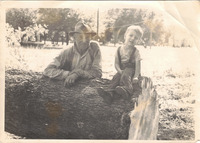
Here, Charles Haushalter (1880–1963) takes a brief respite from the heavy labor of the farm, perched upon a massive, freshly felled log. Beside him sits his grandson, looking up with the bright curiosity of early childhood. The rough bark of the timber and the sturdy suspenders worn by both generations speak to a life lived close to the earth. It is a quiet, unposed snapshot of continuity—a passing of time captured amidst the trees of Water Valley.
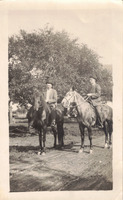
Along the unpaved main road in Water Valley, Charles Haushalter (1880–1963) and an unidentified companion pause on horseback. The setting is familiar and domestic, with a few apple trees near the farmhouse providing a leafy backdrop. Dressed in the sturdy jackets and hats of the early 20th century, the men sit with a composed presence. The dirt road beneath them marks the landscape of a different era, a time when the farm’s connection to the community was defined by these unpaved thoroughfares and the steady rhythm of the horse.
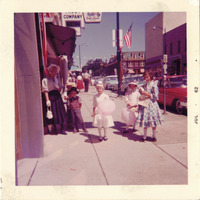
The summer sun of July 1962 warms the sidewalks of Hamburg, New York, as the town celebrates its Sesquicentennial. Amidst the festive bunting and the hum of mid-century traffic, Catherine, the granddaughter of Anna Louise Zdunek (1885–1959) and Charles Heinrich Haushalter (1880–1963) stands in a bright white dress, clutching a pink balloon. The scene captures a moment of community pride and youthful lightness, set against the backdrop of a town marking 150 years of history.
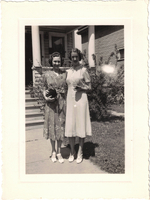
On a bright July day in 1938, Doris Virginia Haushalter (1914–2003) and Dolores Inez Stunick (1917–1998) pause for a portrait outside a residence in Niagara Falls. Standing before the porch of the Michael Stunick house, the two women embody the effortless style of the late Depression era, from their carefully waved hairstyles to their light summer dresses. This snapshot, captured just a year before the world shifted toward war, preserves a quiet moment of companionship. Whether a planned visit or a casual summer afternoon, the image captures a sense of grace and poise before the complexities of the coming decade.
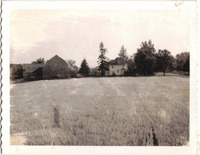
From the vantage point of the Casler residence, the landscape unfolds with the sturdy farmhouse nestled among mature trees and the massive barn standing sentinel to the left. The wide field in the foreground, likely a seasonal crop, stretches toward the buildings that anchored the family for generations. With Gowanda State Road just on the edge of the frame to the right, the scene reflects the intersection of domestic peace and the working agricultural life that defined this fifty-acre property.
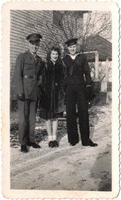
In the winter of 1943, the Haushalter farm in Water Valley provided a brief sanctuary from the rigors of World War II. Mac Robinson, an Army soldier, stands alongside Carl Haushalter (1925–2012), then serving in the Navy, and an unidentified woman in a heavy fur coat. The snow-dusted ground and the sturdy presence of the farmhouse in the background frame a moment of camaraderie.
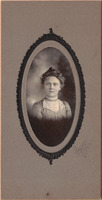
This elegant studio portrait captures a young Ada L. Gallman (1881–1969) at the dawn of the Edwardian era. Taken approximately four years before her marriage to George Jacob Haushalter, the image serves as a poignant record of her youth. Ada is styled in the fashionable aesthetic of the early 1900s, featuring a voluminous pompadour hairstyle and a high-collared lace blouse that reflects the period's emphasis on modesty and refined femininity. The portrait is presented in a classic oval embossed mount, a popular format for professional studio photography of the time.
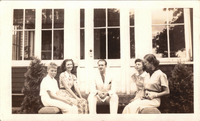
A summer afternoon at the Haushalter farm captures a moment of camaraderie on the back steps. Seated from left to right are Carl Haushalter (1925-2012), an unidentified individual, Carl Stunick (1913-1958), June Haushalter (1920-2025), and Doris Haushalter (1914-2003).